About Leucospermum patersonii E.Phillips
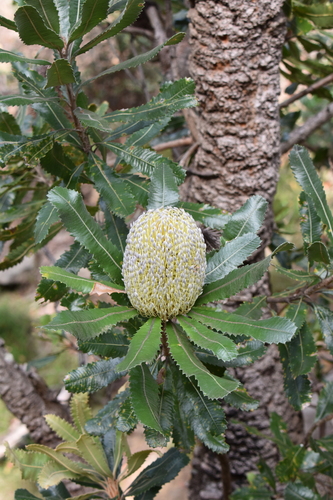
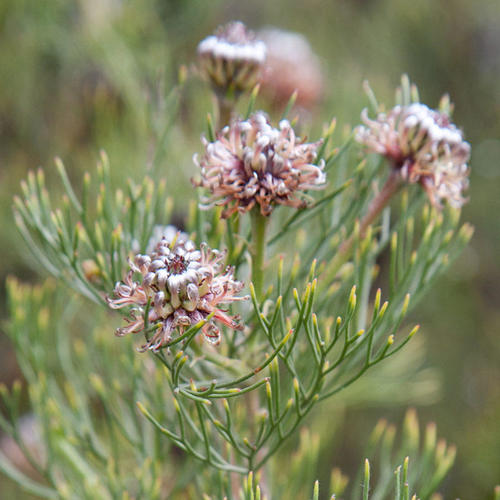
Leucospermum patersonii, commonly called silveredge pincushion, is most often a large, rounded shrub, and sometimes grows as a small tree reaching up to 4 m (13 ft) in height. It has a stout trunk 10–20 cm (4–8 in) in diameter, covered in thick corky bark. Its upright, woody flowering stems are 8–10 mm (0.31–0.39 in) in diameter, densely covered with short fine crinkled hairs, plus some straight, spreading hairs. Hairless leaves are arranged alternately, oriented upward, overlapping and crowded near branch tips. Leaves range from almost round to rounded rectangular, 5–9 cm (2.0–3.5 in) long and 3–5 cm (1.2–2.0 in) wide, with a heart-shaped base or lobes that extend past the stem. The leaf tip is rounded, marked by three to eight deep, bony teeth.
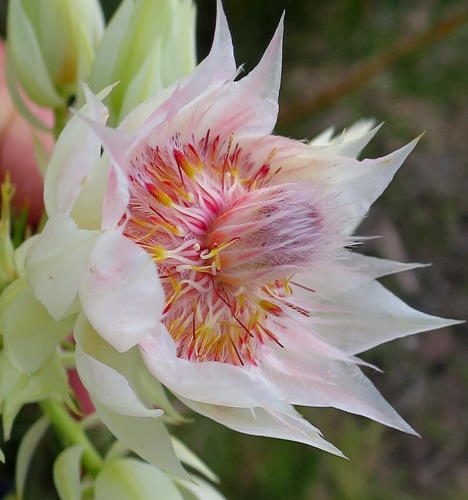
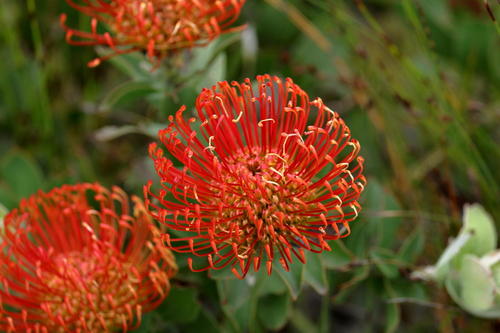
Flower heads are egg-shaped to globe-shaped, around 8–9 cm (3.1–3.5 in) across. They usually grow individually, but occasionally form clusters of two or three, each on a stalk 1–2 cm (0.39–0.79 in) long. The common base of all flowers within a single head is narrowly cone-shaped with a pointed tip, 4–5 cm (1.6–2.0 in) long and 7–10 mm (0.28–0.39 in) wide. The bracts that subtend the flower head are pointed-oval in shape, around 10 mm (0.39 in) long and 7 mm (0.28 in) wide, tightly pressed and overlapping, with a cartilaginous texture. These bracts are either finely powdery-hairy or hairless. The bracts at the base of each individual flower are inverted egg-shaped, convex and keeled, with a pointed tip, densely woolly near the base, about 10 mm (0.39 in) long and 8 mm (0.31 in) wide.
The 4-merous perianth is 2+1⁄2–3 cm (0.98–1.18 in) long, very strongly curved toward the center of the head when in bud, and ranges in color from orange to crimson. In the lower tube section, where lobes stay merged after the flower opens, the lobes taper, are about 5 mm (0.20 in) long, cylinder-shaped and hairless. In the middle claw section, where the perianth splits lengthwise, lobes curve back toward their base when the flower opens, and are densely covered in woolly hairs. The upper section, which encloses the pollen presenter in bud, is made of four strongly recurved, oval limbs around 4 mm (0.16 in) long. These limbs are either hairless or have some stiff, bristly hairs. A style 4+1⁄2–5 cm (1.8–2.0 in) long emerges from the perianth, and is strongly bent toward the center of the head. The pollen presenter, the structure that receives pollen from anthers while the flower is still in bud, is shaped like a skewed spinning top, 3–4 mm (0.12–0.16 in) long and about 2 mm (0.079 in) in diameter, with an oblique groove that acts as the stigma across its very tip. The ovary is subtended by four awl-shaped pale orange scales around 4 mm (0.16 in) long.
Distribution, habitat and ecology: L. patersonii occurs along the coast from Cape Agulhas in the east to Stanford, with an outlying population at Heuningklip Kloof near Kleinmond. It once grew near Hermanus, but is now locally extinct there. Silveredge pincushion is a coastal species, almost entirely restricted to limestone ridges next to the sea, at altitudes between 50 and 250 m (160 and 820 ft). Except for the population at Heuningklip Kloof, the species grows on limestone of the Alexandria Formation. Its roots mostly penetrate the soft limestone layers closer to the surface. Silveredge pincushion usually grows in fairly dense stands, in vegetation that also hosts other Proteaceae species preferring limestone, including Mimetes saxatilis, Protea obtusifolia and Leucadendron meridianum. If periodic fynbos wildfires are not too hot, mature plants can regenerate from the tips of their branches.
Cultivation: The upright growth habit and large, conspicuous flower heads make L. patersonii attractive as both a cut flower and an ornamental garden species. Because it is adapted to alkaline lime-containing soils, it is used to breed hybrids that can grow across a range of soil types. Several such hybrids have been developed by crossing L. patersonii with L. conocarpodendron, a species that is itself intolerant of lime.