About Leucospermum parile Knight ex Loudon
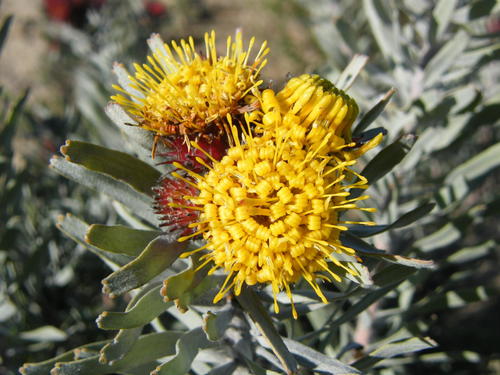
Leucospermum parile, commonly known as the Malmesbury pincushion, is a generally upright, rounded shrub that reaches up to 1½ meters (4.9 ft) in height, growing from a single stout trunk. Many of its lowest branches spread along the ground, while upright flowering stems are round in cross-section and covered in felty hairs. Its leaves point slightly upwards and overlap somewhat, and are linear to broadly linear. The leaves measure 4–6 cm (1.6–2.4 in) long and 6–8 mm (0.24–0.31 in) wide, covered in a dense grey layer of short crisped hairs, and their tip may be smooth or bear up to three teeth. Flowering occurs between July and November. The strongly sweet-scented flower heads are globular or slightly flattened at the top, 3–3½ cm (1.2–1.4 in) in diameter, are stalkless or nearly stalkless, and grow in clusters of 1 to 6 near the tips of flowering branches. The common base that supports all flowers in a single head is broadly cone-shaped with a pointed tip, about 14 mm (0.55 in) high and 10 mm (0.39 in) across. The bracts that subtend the entire flower head become hairless as they mature, are reddish-brown, about 1 cm (0.39 in) long and ½ cm (0.20 in) wide, papery in texture, oval with a pointed tip that may be upright or slightly recurved. These bracts sometimes have a thin tuft of stiff hairs, and sometimes have a regular row of hairs along their edge. The bracts subtending each individual flower are lance-shaped with a pointed tip, 10 mm long and 3 mm wide; their outer surface is woolly near the base and hairless higher up, except for a tuft of stiff hairs at the tip. The rich yellow perianth is 4-parted, straight in bud, and measures 1½–2 cm (0.59–0.79 in) long. The lower merged portion of the perianth, called the tube, is hairless, cylinder-shaped but slightly compressed sideways, and about 4 mm (0.16 in) long. The split middle lobes, called claws, are 9–12 mm (0.35–0.47 in) long; the claw facing the edge of the flower head is hairless, while the other three are covered in soft hairs. The upper portion, which encloses the pollen presenter within the bud, consists of four narrowly lance-shaped segments around 4 mm (0.16 in) long; the segment facing the head edge is hairless, and the other three bear few glandular hairs. A straight style 1½–2 cm (0.6–0.8 in) long emerges from the perianth. The ovary is subtended by four opaque awl-shaped scales around 1½ mm (0.06 in) long. This species is only found in a small area within Malmesbury District, South Africa, ranging between Mamre Moravian Road station and Abbotsdale in the north, Dassenberg in the west, and Kalbaskraal in the south. It grows on flats in strandveld vegetation, in fairly fine, nutrient-poor white sands of Tertiary origin that contain almost no organic matter. It occurs at elevations between 30–150 m (98–492 ft). Within its range, annual precipitation is 375–500 mm (14.8–19.7 in), and falls mostly in the winter months. Associated vegetation includes multiple Erica species, Cryptadenia, Serruria, Passerina, and low tufted Restionaceae. Most individuals begin flowering around three years after germination. The species is pollinated by insects, particularly butterflies, bees, and beetles. Fruits fall to the ground around two months after flowering, and are collected by ants that carry them to underground nests. Ants eat the pale outer layer of the fruit that attracts them, leaving the remaining seeds within the nests, where they are protected from fire and consumption by rodents and birds. Adult plants cannot survive fire. Studies of phosphorus content across the species' biological life cycle have found that seeds contain large amounts of phosphorus compounds. During the first two years after germination, phosphorus compounds concentrate in the leaves. In senescent (aging) plants, leaf phosphorus content is lower, and phosphorus has moved to developing seeds. This life cycle shift in phosphorus distribution is likely representative of many other species growing in fynbos and other nutrient-poor soils.