About Leucospermum oleifolium (P.J.Bergius) R.Br.
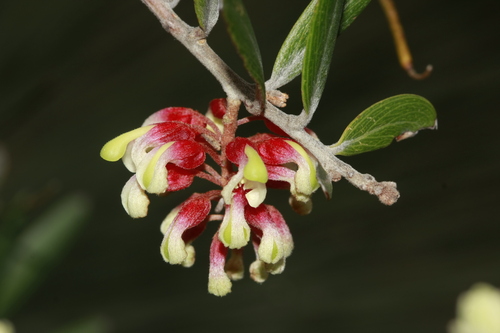
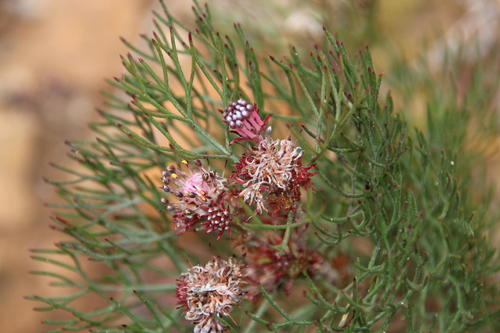
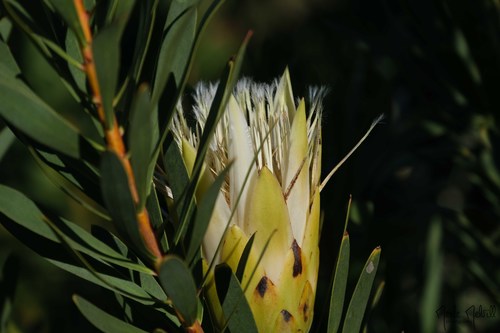
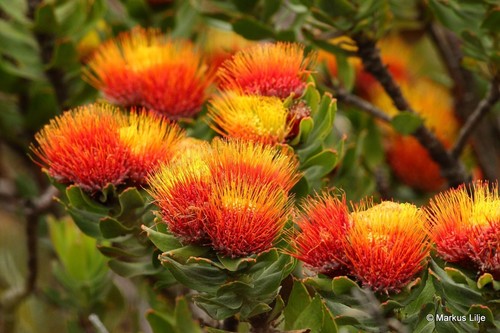
Leucospermum oleifolium (P.J.Bergius) R.Br. is an erect, typically compact and rigid shrub that reaches around 1 meter (3.3 feet) in height and 1.5 meters (5 feet) across, with a single stem at its base and upward-curving branches. Flowering stems are 3–6 mm (0.12–0.24 in) in diameter; they are covered in soft hairs when young, and lose these fine hairs as they mature. The leaves have no stalks or bracts at their base, are also initially softly hairy, and lose their covering of fine hairs (indumentum) as they age. Leaves measure 4–6 cm (1.6–2.4 in) long and 8–25 mm (0.31–0.98 in) wide, with an entire, sometimes wavy margin, and a bony tip that may carry one to five blunt teeth. The cup-shaped flower heads are each 2.5–4 cm (1.0–1.6 in) in diameter, almost lack a stalk (peduncle), and are arranged in clusters of two to five crowded at the end of branches, occasionally growing singly. The floral base is flat and 12 mm (0.47 in) in diameter. Below the floral base, it is covered by overlapping, egg-shaped, long-pointed involucral bracts that are felty to hairless and papery, measuring 9–36 mm (0.35–1.42 in) long and 5–7 mm (0.20–0.28 in) wide; sometimes these bracts have a tuft of long hairs at their tip. The papery bracts at the base of individual flowers are very narrowly lance-shaped, 1–3 cm (0.39–1.18 in) long, woolly near the base, and softly hairy towards the tip. Individual flower buds are straight tubes around 2 cm (0.79 in) long, slightly transparent, initially whitish-transparent to pale yellowish green. They turn yellow when opening, quickly change to orange, and become bright crimson as they age. When the flower opens, a cylindrical, hairless tube 8 mm (0.31 in) long remains, which widens toward the top, with four thread-shaped lobes that curl tightly inward. The styles are initially strongly arched like a swan's neck, then straighten and grow quickly to form a 2.5–3 cm (1–1 1/4 in) thread; they are pale yellow at first, turning crimson when fully developed. The pollen-presenter, a slight thickening at the tip of the style (comparable to the head of a pin), is cylindrical and thread-like, only slightly thicker than the style at its base, and 1 mm (0.039 in) long, with a stigma that forms a groove across the pollen-presenter's tip. At the base of the ovary, there are four blunt, thread-like, opaque scales around 2 mm (0.079 in) long. The fruit is ellipsoid in shape, 7.5 mm (0.3 in) long, with a surface thinly covered in fine powder. This species flowers between August and January, peaking in September and October. Flowers start bright yellow, soon turn orange, and end as brilliant crimson, and can remain vibrant for almost two months. The genus Leucospermum belongs to the subtribe Proteinae, which consistently has a basic chromosome number of twelve, with 2n=24 for this species. Leucospermum oleifolium occurs from Rooiels in the south, through the Kogelberg Nature Reserve, Hottentots Holland Mountains, Franschhoek, and Villiersdorp, to the Haweqwa Nature Reserve; there is also an isolated population around Bainskloof Pass to the north, and the species extends eastwards along the Riviersonderend Mountains to Tyger Hoek. It can grow on very well-drained coastal rocks only 50 m (150 ft) from the high tide line, and also on cool peaty slopes at 900 m (3,000 ft) elevation. It is found in the winter rain zone in Fynbos growing on weathered Table Mountain Sandstone, only in locations where the mean annual precipitation is at least 75 cm (30 in). L. oleifolium grows in dense sclerophyll vegetation made up mostly of other Proteaceae, Erica species, and Restionaceae. In the southern part of its range, hundreds of individuals grow close together, while toward the north and east, plants grow more spaced apart from one another. The flowers are self-sterile. When the shrubs are in flower, many Cape sugarbirds (Promerops cafer) and several sunbird species visit and pollinate the flowers. Small insects are drawn to the abundant nectar produced in the early morning, providing additional food for these birds. Each flower head only produces a few large, hard, nut-like seeds, which are collected by ants and stored underground. In the fynbos where this species grows, natural wildfires occur every one to two decades, and few plants survive the fire. After the fire, rain carries fire-created chemicals underground that trigger the seeds to germinate, allowing the species to be resurrected. Burnt plant biomass also adds nutrients to the soil that can support new growth.