About Leucospermum gueinzii Meisn.
The kloof pincushion, Leucospermum gueinzii Meisn., is a stout, upright evergreen shrub that reaches 2–3 m (6–9 ft) in height. It grows from a single main stem, with branches that curve upward or grow upright from the base. Its flowering stems are 6–9 mm (0.24–0.36 in) thick, covered in fine short crinkly hairs, with longer erect hairs growing between them. Its leaves are either hairless, or rarely have a light coating of powdery hairs when young. The leaves are pointed lance-shaped to elliptic, bright green, 7 1⁄2–10 cm (3–4 in) long, and have an entire margin that ends in one bony reddish tip, or rarely two to four reddish teeth near the tip. The leaves are stalkless, held at an upward angle, and overlap each other.
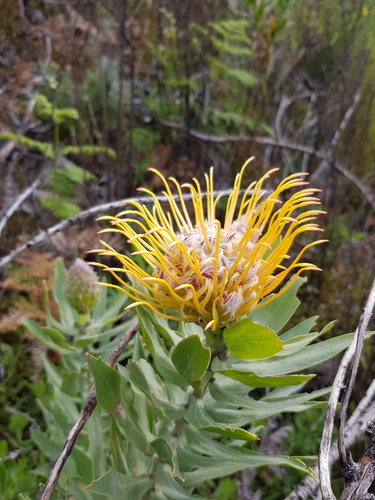
Flower heads are egg-shaped when opening, and become flatter as they mature. They measure 10–14 cm (4–5 1⁄2 in) in diameter, and are most often set individually, though sometimes two or three grow clustered together. Each flower head sits on a stalk up to 1 cm (0.4 in) long. The common base that all flowers in a single head attach to is narrow cone-shaped with a pointed tip, 4–4 1⁄2 cm (2.6–2.8 in) high and 1–1 1⁄4 cm (0.4–0.5 in) across at the base. The bracts that subtend the entire flower head are broad oval with a pointed tip, with the highest whorl of bracts having a pointed tip. These bracts are 15–24 mm (0.60–0.96 in) long and 5–8 mm (0.20–0.36 in) wide, cartilaginous at the base, brown and papery near the tip. Their margins have a dense regular row of hairs, and the tip mostly has a tuft of long stiff hairs. The bracts that subtend each individual flower are pointed lance-shaped, 2 1⁄2–3 cm (1.0–1.2 in) long and 5–9 mm (0.20–0.36 in) wide, with a cartilaginous texture. They are thickly covered in woolly hairs at the base, have a regular row of hairs along their margins, and fine stiff hairs at the tip.
The 4-merous perianth is 5 1⁄2–6 cm (2.2–2.4 in) long, greenish yellow at the base and amber-colored near the tip. The lower part of the perianth, which remains merged when the flower opens, is about 7 mm (0.28 in) long, hairless, narrow at the base, and somewhat bulging toward the center of the head higher up. The middle part, or claws, is covered in fine hairs plus some longer straight hairs, and curls back once the flower has opened. The upper part, or limbs, which encloses the pollen presenter while the flower is in bud, is made of four pointed, very narrowly lance-shaped lobes, three of which cling together. Each lobe is about 1 cm (0.4 in) long and 2 mm (0.08 in) wide, roughly hairy on the outside with some long hairs, and has a tuft of stiff hairs at the tip. Emerging from the center of the perianth is a tapering, deep orange style 7–7 1⁄2 cm (2.8–3 in) long, that is strongly curved toward the outside of the head near the pollen presenter. The thickened tip of the style, called the pollen presenter, is cylinder-shaped with a pointed tip, 8–10 mm (0.32-0.40 in) long, with the groove that acts as the stigma across the very tip. The ovary is subtended by four ivory-colored, awl-shaped scales about 3 mm (0.12 in) long.
Kloof pincushion is an endemic species restricted to a small area in the Hottentots Holland Mountains of South Africa, specifically occurring on the Helderberg, Jonkershoek, Bushmans Castle, and near Sir Lowry's Pass. It was originally collected by Karl Ludwig Philipp Zeyher at Houw Hoek, but populations there have since disappeared. The average annual precipitation across its distribution range is 750–1150 mm (30–45 in), with most rain falling in the winter. As a result, it grows in much wetter locations than its similar-looking relative L. grandiflorum. It mostly grows in dense sclerophyll vegetation in sheltered locations near running water, such as gorges, at altitudes between 300 and 900 m (1000–3000 ft). It only grows on heavy clay soil formed by the weathering of Cape Granite.