About Leucospermum gracile (Knight) Rourke
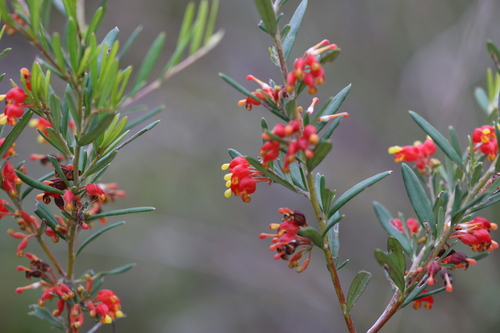
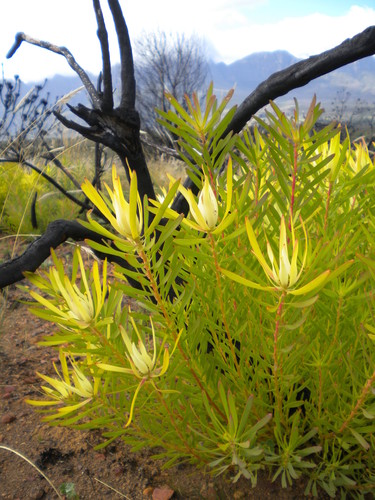
Leucospermum gracile is a low, spreading shrub 30–40 cm (1–1⅓ ft) tall. It grows from a basal trunk and forms open mats up to 1½ m (5 ft) in diameter. Its reddish flowering stems are slender, 2–3 mm (0.08–0.12 in) thick, covered in a felty texture, and sometimes become hairless over time, trailing along the ground.
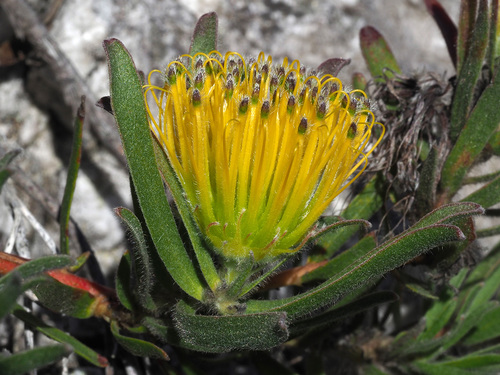
Its leaves are thinly felty or powdery, shaped oblong to linear. They measure 2–4½ cm (0.8–1.8 in) long and 2–5 mm (0.08–0.20 in) wide, with a blunt far end. Leaves may be entire or split into three lobes, each ending in a thick, bony tooth, and have a blunt or cut-off base. Most leaves are widely spaced, pointing straight upward, and sometimes grow at a more relaxed angle.
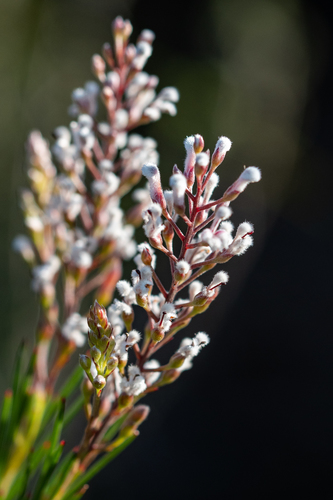
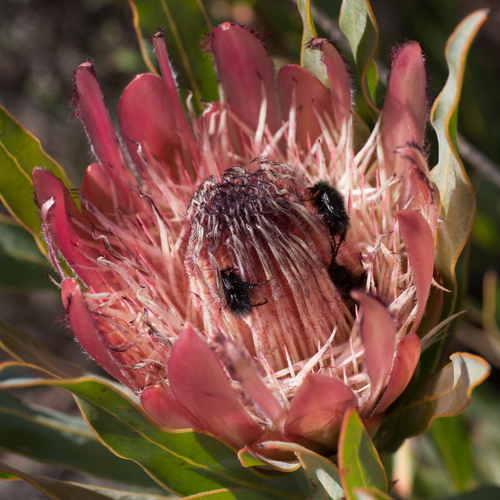
The flower heads are whorl-shaped or turbinate, 2½–3 cm (1.0–1.2 in) in diameter. They are either seated or have a stalk up to 2 cm long, and usually grow at a right angle to the stem. The common base that supports all flowers in one head is flat and around ½ cm (0.2 in) wide. The bracts subtending the entire head are very narrowly lance-shaped to linear, 8–10 mm (0.32–0.40 in) long and 1–1½ mm (0.04–0.06 in) wide, with a pointed tip. Their tips end in a small tuft of short hairs, they have hairs along their edges, their surface is softly hairy, they have a cartilaginous texture, and the bracts overlap one another. The individual bract subtending each single flower is inverted lance-shaped, ending abruptly in a sharp or pointed tip, 5–6 mm (0.20–0.24 in) long and around 1½ mm (0.06 in) wide. It is cartilaginous in texture, with a very thickly woolly surface.
The 4-merous perianth is 2–2½ cm long, greenish at the base and yellow toward the upper portion. The lowest, fully fused section of the perianth, called the tube, is funnel-shaped, 8 mm (0.32 in) long, hairless, and has a fine powdery texture near the top. The middle section, or claws, where the perianth splits lengthwise, is thread-shaped (filiform) and tightly curls backward near the tip. The lobe facing the edge of the flower head is hairless, while the other is roughly hairy. The upper section, or limbs, which encloses the pollen presenter within the bud, consists of four 1 mm (0.04 in) long, pointed, narrowly lance-shaped lobes that are hard to distinguish from the perianth claws.
A straight, thread-shaped style emerges from the perianth, 2½–3 cm long, tapering toward the tip. It is initially yellow, and later turns pale green. The thickened tip of the style, called the pollen presenter, is 1.0 mm long, cylinder-shaped with a pointed tip, and barely distinct from the style. A groove that acts as the stigma runs across the very tip of the pollen presenter. The ovary is surrounded by four opaque, hoof-shaped scales around 3 mm long. Leucospermum belongs to the subtribe Proteinae, which consistently has a basic chromosome number of twelve, with 2n=24.
In terms of distribution, habit and ecology: Leucospermum gracile occurs from Shaw's Mountain between Caledon in the north and Hermanus, through the Onrus Mountains and Kleinrivier Mountains, eastward to hillsides near Napier. It usually grows at altitudes between 100–300 m (300–1000 ft), and may occasionally reach 900 m (3000 ft). It always grows in very well-drained locations, particularly in sandy surface layers of weathered, crumbling Table Mountain Sandstone. A northern population near Bot River, collected by Schlechter, is likely extinct due to agricultural development. This species is pollinated by birds. Ripe fruit falls to the ground around two months after flowering. Native ants carry the fruits to their underground nests to eat the elaiosome. The seeds stay dormant until a fire destroys the above-ground plant biomass.