About Leucospermum cuneiforme (Burm.fil.) Rourke
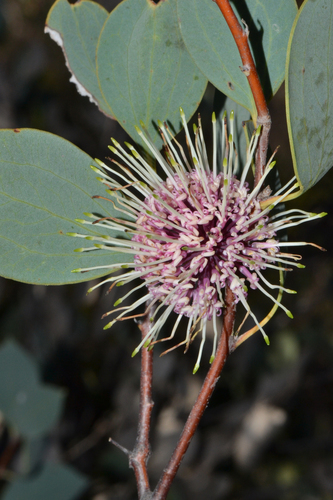
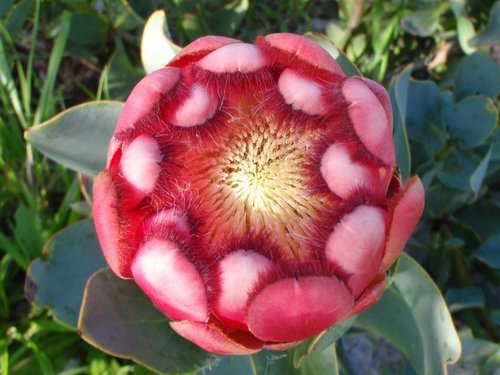
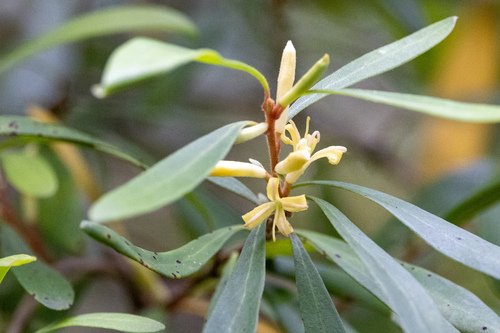
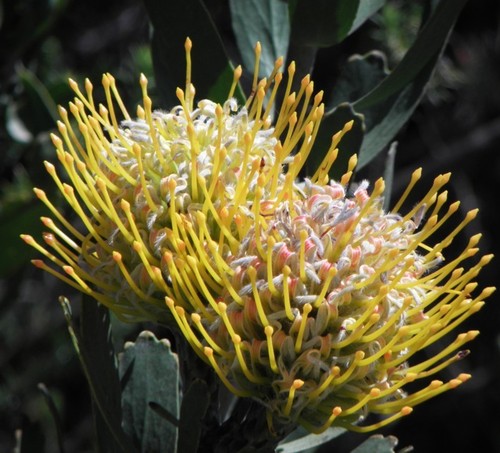
Leucospermum cuneiforme (Burm.fil.) Rourke is an upright, evergreen shrub. It most often reaches only ½–1 m (1½–3 ft) high, growing multiple branches from a woody underground rootstock. If protected from fire, it can develop a main stem and grow up to 3 m (9.8 ft) high. A unique feature of this species is that the stem and lower branches are covered in pustules. Its upright flowering branches are 3–7 mm (0.12–0.28 in) in diameter, and appear grey from a covering of soft, crinkly hairs. Its leaves are hairless, ranging from narrow to broadly wedge-shaped, 4½–11 cm (1.8–4.4 in) long and 0.6–3 cm (0.24–1.18 in) wide, with 3 to 10 bony-tipped teeth near the leaf tip. The plant's egg-shaped flower heads usually grow solitary, or in groups of two or three at branch ends, 5–9 cm (2.0–3.5 in) in diameter, each on a stalk up to 1½ cm (0.6 in) long. The common base of the flowers within one head is cylindrical with a blunt tip, 2½–4½ cm (1.0–1.8 in) long and 6 mm (0.24 in) wide. The bracts that subtend the flower head are broadly oval with a pointed tip, about 0.8–1.0 cm (0.31–0.39 in) long and 6 mm (0.24 in) wide, closely overlapping, rubbery in texture, and grey from dense soft hair. The bracts subtending each individual flower are oval with a pointed tip, 1.0–1.2 cm (0.39–0.47 in) long and about 7 mm (0.28 in) wide, rubbery in texture, wrapping around the base of the perianth, densely woolly at the base, with less dense hair closer to the tip and a dense row of hairs along the edges. The perianth is 2½–4 cm (1.0–1.6 in) long, curved toward the center of the flower head when in bud. It is initially yellow, later turning orange, though its exact color varies across its distribution range. Its base is fused into a 6–10 mm (0.24–0.39 in) long tube that is slightly flattened side-to-side, smooth at the base and covered in a fine powdery coating near the top. Three of the perianth lobes coil back toward the center of the flower head, covered in many fine, short crinkly hairs and some long straight silky hairs. The style is 3¾–5½ cm (1½–2¼ in) long, slightly curved toward the center of the flower head, and starts yellow before turning orange like the perianth. It is topped by a slight thickening called the pollen presenter, which is narrow to broadly cone-shaped, 1½–4 mm (0.6–1.6 in) long and up to 2 mm (0.079 in) wide, with a groove that acts as the stigma located centrally at its very tip. The four scales that subtend the ovary are triangular to awl-shaped and about 1 mm (0.039 in) long. L. cuneiforme has the largest distribution range of any species in its genus Leucospermum. It occurs all along the southern coast of South Africa's Western Cape and Eastern Cape provinces, and in adjacent mountain ranges, from Greyton (Caledon district) in the west to Qolora Mouth in Transkei in the east. Its distribution includes the Riviersonderend Mountains, Potberg, Langeberg Range, Outeniqua Mountains, and Swartberg Mountains. It grows in a range of climates, with peak rain falling in winter, summer, or with no clear rainy season. It can grow in sclerophyll fynbos, such as on the south-facing slopes of the Langeberg alongside other Proteaceae, Erica species, Rutaceae, and Restionaceae, as well as in grassveld, and subtropical dune forests in the Eastern Cape where it grows alongside species including Phoenix reclinata and Stangeria eriopus. It also occurs on the arid fringe of the Little Karoo, and on the wet margins of temperate evergreen forests near Knysna and Tsitsikama. It only grows in poor sandy soils derived from Table Mountain Sandstone, Witteberg Quartzite, or stabilised sandy Tertiary deposits. It can be found from sea level up to over 1,000 m (3,300 ft) in altitude. L. cuneiforme is one of the most fire-resistant pincushion proteas. While fire kills all above-ground parts of the plant, multiple new branches sprout from its surviving woody rootstock. The typical frequency of wildfires keeps most shrubs at ½–1 m (1½–3 ft) high, but when fire is absent, it develops a dominant main stem and reaches up to 3 m (9.8 ft) high. A small number of flowers can be found year-round, but there is a distinct flowering peak from August to February. The unscented, brightly conspicuous flower heads are pollinated by nectar-feeding birds, including the Cape sugarbird and several sunbird species. The birds perch on the flower head and insert their long bills into perianth tubes, bringing their heads and necks into contact with the pollen presenters to pick up and deposit pollen. While insects also visit the flowers, they do not touch the pollen presenters so they do not contribute to pollination. The plant's seeds are covered in a pale fleshy coating called an elaiosome that attracts ants. Around two months after flowering, ripe seeds are released from the flower heads. Native ants collect the seeds and carry them back to their underground nests, where they eat the elaiosome. The remaining seed is large, smooth and hard, so ants cannot remove it from the nest. This leaves the seed safe from seed predators and fire. This seed dispersal strategy is called myrmecochory. After a fire, stored seeds germinate quickly. Because of this and its ability to resprout from the rootstock, L. cuneiforme has two different strategies to survive wildfires. In cultivation, L. cuneiforme is grown as an ornamental shrub, and is also cultivated for use as a cut flower. Several cultivars exist, including 'Goldie', alongside multiple hybrids between L. cuneiforme and other Leucospermum species.