About Leucosidea sericea Eckl. & Zeyh.
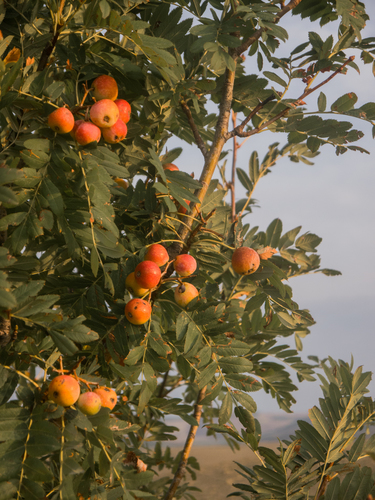
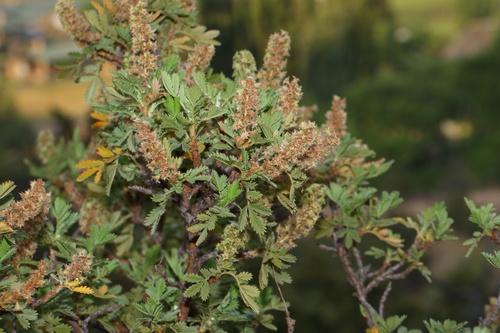
Commonly called oldwood, Leucosidea sericea Eckl. & Zeyh. is most often a straggly shrub or a dense, small evergreen tree. It grows up to 7 metres tall and 5 metres wide, and can be single-stemmed or multi-stemmed, with branches that start low on the plant. Its bark is rough and reddish brown, and flakes off to reveal a smooth light brown under-bark. Its leaves are alternately arranged and compound, covered with silky silver hairs. Each leaf holds 3 to 4 pairs of leaflets. Leaf veins are deeply sunken on the upper leaf surface and protrude out from the lower surface. Foliage is dark green above and lighter green below, with deeply serrated margins on the leaflets. Crushed leaves give off a strong herb-like scent. The greenish-yellow, star-shaped flowers grow in spikes at the ends of young shoots in spring, from August to September. The nut-like fruits, around 3 mm in diameter, develop from December to January. In spring, cattle and goats browse the flowers and young shoots of this plant. Oldwood produces nectar that is likely used by bees and other insects. Leucosidea sericea occurs at elevations above 1,000 metres (3,300 ft) in the highlands of South Africa, specifically in Eastern Cape, western KwaZulu-Natal, eastern Free State, North West Province, Gauteng, Mpumalanga, and Limpopo. It also grows in Lesotho, and is rarely found in Eswatini and Zimbabwe. It typically grows in dense thickets in open grassland, along river banks, and on wooded rocky ridges, in damp conditions on deep, sandy or clayey, often rocky soil. It forms dense thickets in disturbed areas, contributing to woody plant encroachment on farmlands, and its presence indicates overgrazing or poor veld management. In mountainous regions, oldwood growing near streams is considered an indicator that the streams are suitable for stocking with trout. Zulu people use a paste made from crushed Leucosidea sericea leaves to treat ophthalmia, an eye ailment. Local communities use the tree as a charm to protect people living in homesteads. Some indigenous South African groups use the plant's leaves medicinally as a vermifuge and an astringent. One study has found the plant has antimicrobial activity against Staphylococcus aureus, Bacillus subtilis and Candida albicans. The wood of Leucosidea sericea weighs 38 pounds per cubic foot (0.61 g/cm3), and is mainly used for fenceposts and fuel.