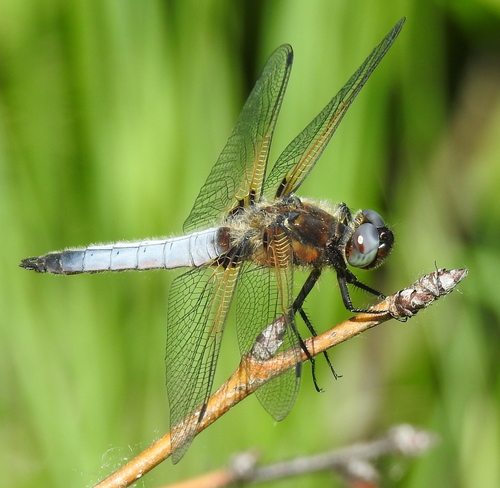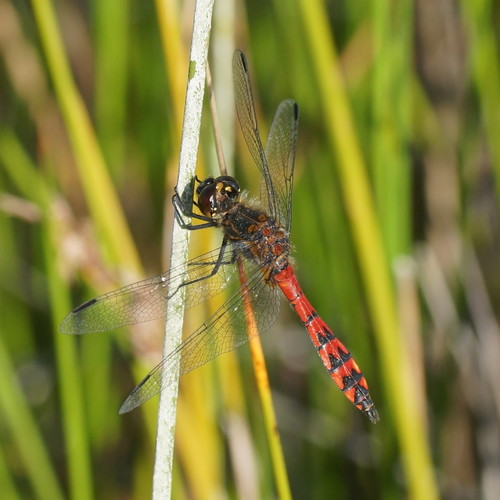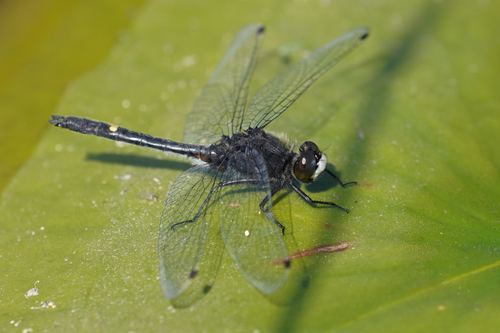
About Leucorrhinia intacta (Hagen, 1861)
The dot-tailed whiteface, whose scientific name is Leucorrhinia intacta, is a dragonfly species in the family Libellulidae. It is one of the most common and widespread species in the genus Leucorrhinia. It is distributed across a large range of states and territories in the United States including Alaska, California, Colorado, Connecticut, Delaware, Iowa, Idaho, Illinois, Indiana, Kansas, Kentucky, Massachusetts, Maryland, Maine, Michigan, Minnesota, Missouri, Montana, Nebraska, North Dakota, New Hampshire, New Jersey, Ohio, Oregon, Pennsylvania, Rhode Island, South Dakota, Tennessee, the U.S. Virgin Islands, Utah, Vermont, Washington, Wisconsin, West Virginia, and Wyoming. In Canada, it can be found in Alberta, British Columbia, Manitoba, New Brunswick, Nova Scotia, Nunavut, Ontario, Prince Edward Island, Quebec, and Saskatchewan. This species lives near boggy, marshy ponds and lakes, as well as beaver ponds. It is frequently found around farm ponds that contain water lilies. On hot, sunny days, dot-tailed whitefaces can be seen basking in open clearings on the ground or on twigs. Naiads of this species live in submerged vegetation. Instead of actively chasing prey, they wait for prey to pass by them; this ambush strategy also helps protect them from other predators. Naiads emerge as adult dragonflies at night. Adult dot-tailed whitefaces generally fly from early June to early August, though flight periods sometimes fall in different months. Compared to many other whiteface dragonflies, this species prefers warmer habitats, and is often found sitting on lily pads in heavily vegetated ponds. It hunts from shoreline vegetation, where it perches to wait for prey. After mating, the male actively guards the female he mated with by flying above her while she lays eggs, in order to prevent other males from mating with her. The female lays her eggs by dipping the tip of her abdomen into the water while hovering just above the water surface.