About Leucorrhinia albifrons (Burmeister, 1839)
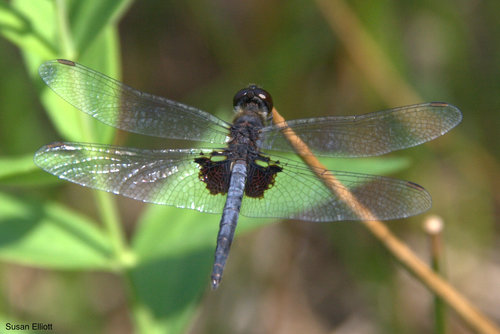
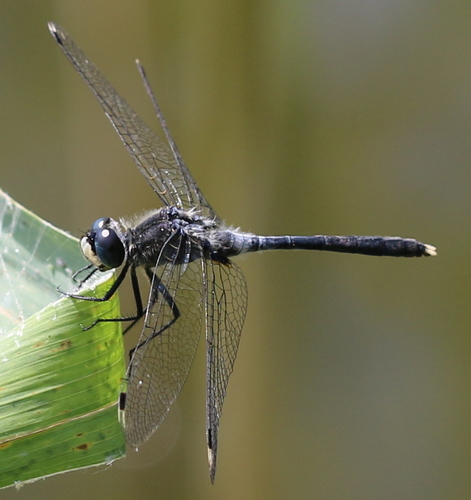
This species is a medium-sized dragonfly in the genus Leucorrhinia, with a dark, dull overall appearance. Mature males have a frosted bluish-grey color. It can be told apart from other species in its genus by the distinct white patches on its labium. Compared to the lilypad whiteface, it is smaller and sleeker, with a shorter, more diffuse ring at the base of its abdomen. The dark whiteface is a Palearctic species with a range extending from central Siberia and the Altai Mountains to southern Scandinavia and France. It is fairly widespread across northeastern Europe and European Russia. It occurs more rarely in central Europe, and has a patchy, fragmented range in western and southern Europe. It also has a patchy distribution in the non-European parts of Russia. While it was previously extirpated from the Netherlands and Denmark, it has since re-established breeding populations in both countries. It remains locally extinct in Slovakia. Though it is primarily a lowland species, it has been recorded at elevations up to 1,150 meters in the Jura Mountains and up to 1,400 meters in the French Alps. The dark whiteface typically favors nutrient-poor, shallow, stagnant water bodies with abundant vegetation, including ponds, bays, acidic peaty lakes, disused gravel pits, and wetlands. It especially prefers unshaded water bodies surrounded by forest, and has a more patchy distribution in more open habitats. At the edges of its range, it is mainly restricted to mesotrophic lakes, but can also survive in a wider range of eutrophic or nutrient-poor aquatic environments. It can persist in areas with high fish populations as long as there is enough dense vegetation for larvae to hide in. Males are most often observed flying between water lilies, stones, or straws, and perch on these objects to monitor their breeding territories. Females and juvenile males prefer more open, sunny areas adjacent to these water bodies. This dragonfly usually perches on the ground or low vegetation, and only rarely perches on lilypads like the closely related lilypad whiteface. Females typically lay their eggs alone on the surface of the water. Larval development takes three years and occurs in shallow, vegetation-rich water. After development is complete, almost all individuals in a single population emerge as adults at the same time. Adult dark whitefaces can be seen from late April in the southern portion of the species' range, or from late May to mid-August across most of the range, and they are most abundant in June. Exuviae are left on vegetation near the water at a height of a few dozen centimeters.