About Leucopternis princeps P.L.Sclater, 1865
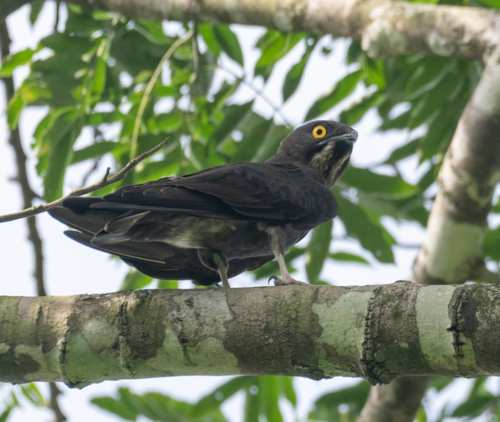
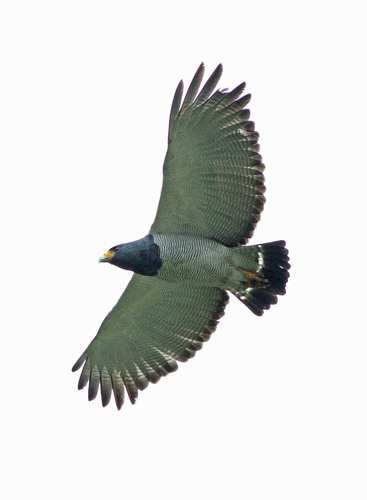
The barred hawk (Leucopternis princeps P.L.Sclater, 1865) appears black from above, with a single white bar on its tail. Its belly and under-wing coverts are white with black barring, which contrasts with the black throat, breast, and wing quills. This species has a snout-like bill that gives the impression of a heavy head. Although it is a fairly large hawk, similar in size to a large member of the Buteo genus, its wingspan is relatively smaller than that of most related large hawks. This smaller wing size allows it to maneuver more easily through thick forest canopies. The barred hawk measures 51 to 61 cm (20 to 24 in) in total length, with a wingspan of 112 to 124 cm (44 to 49 in). Leucopternis princeps weighs approximately 1 kg (2.2 lb). This species displays sexual dimorphism, with females being larger than males. Male wing chord length measures 347–367 mm (13.7–14.4 in), while female wing chord length measures 351–388 mm (13.8–15.3 in). Barred hawks have very broad wings and a short tail, with a wingspan that is 2.2 times the total length of the bird. Their body is dark grey, with a white chest marked with evenly spaced black bars — these bars are the source of the species' common name. The calls of L. princeps include high-pitched screaming or whistling, as well as hoarse "whees", "yips", "dits", and "weeps". Barred hawks are typically noisy when soaring. This species has a total Extent of Occurrence of 350,000 km². It is primarily a Caribbean hawk found at middle altitudes, occurring in Costa Rica, Panama, Peru, both sides of the Andes in northern Ecuador, and western Colombia. Its natural habitat is subtropical or tropical lowland and mountain forest. It occurs at elevations between 300 and 2,500 m (980 and 8,200 ft), and is most abundant between 900 and 1,600 m (3,000 to 5,200 ft).