About Leucopternis polionotus (Kaup, 1847)
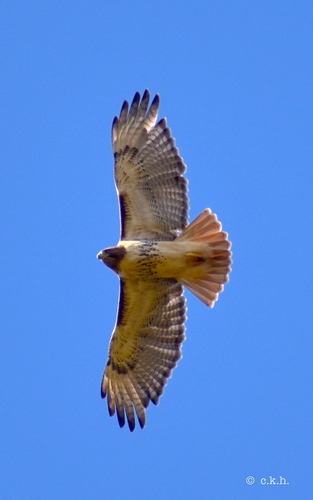
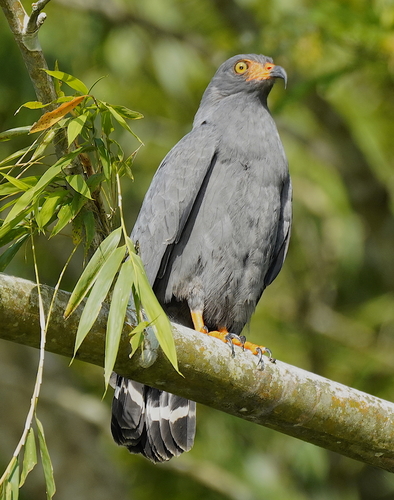
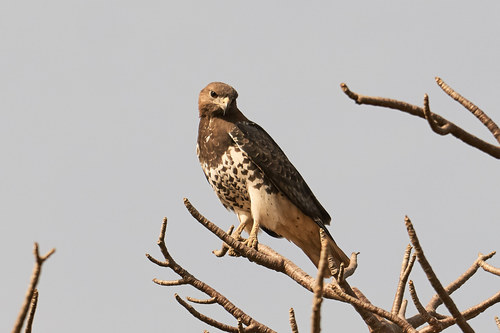
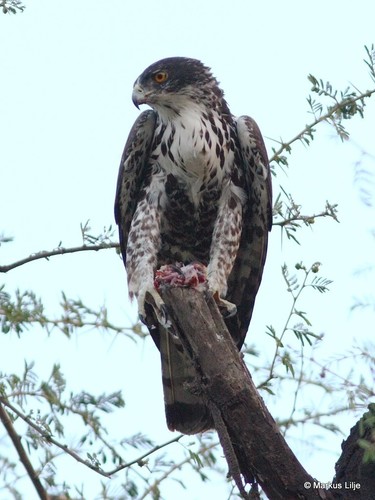
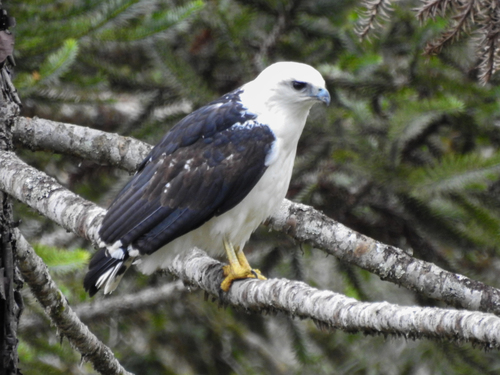
This medium-sized hawk, Leucopternis polionotus, has a bulky build with broad shoulders relative to its total body length. Adult body length ranges from 470 to 510 mm, and females are slightly larger than males. The head, neck, upper back, and entire undersurface are white, with the exception of black wing tips and the basal half of the tail. The round white head appears disproportionately large compared to the rest of the body, and sometimes projects further forward than the tail. Markings around the eyes create a masked appearance. The ceres and lores are grey or dull yellow. The bill is pale grey, gradually darkening to black at the tip. The iris is brown, but often appears black when observed in the field. The toes and tarsi are orange-yellow. The wings, lower back, and rump are black or dark bluish grey. The dark primaries, secondaries, tertials, and upper tail coverts have greyish bases with thin, white square tips. These feathers also have 3 to 4 narrow darker bands, and their broad white tips form a shallow U shape when viewed from behind. The mantle, scapulars, and upper tail coverts are black or slate grey with broad white tips; the coverts are darker than the scapulars and also tipped white, which sometimes creates a barred appearance. When perched, the long primaries reach or extend past the tip of the tail. The long secondaries reach halfway to the tail tip and conceal the rump and base of the tail, making the tail look very short. In flight, this hawk glides on level wings and soars frequently throughout the day. It is easily spotted when perched on exposed positions from distances of over 1 km. When the hawk is seen from below in flight, only the white portion of the square tail is visible, though some individuals may have one or two dark bands visible at the tail base. Overall, this species is similar in appearance and flight pattern to the white-necked hawk, but Leucopternis polionotus has a broad white leading edge on the wings and a white tail end, which are black in the white-necked hawk. The dark tail base of the white-necked hawk is not usually visible in flight, making it difficult to distinguish the two species in the field. Reported flat wing measurements are 360 to 380 mm for males, and 390 to 410 mm for females. Other reported measurements are: tail length 178 to 222 mm, tarsus length 95.3 mm, and culmen length from the cere 29 to 30 mm. Juveniles are similar to adults, but their plumage is fairly spotted overall, with dark streaks on the white crown and nape that are visible at distance. The upper wing coverts have whitish fringes, and there are more numerous and more noticeable dark bars at the base of the tail than seen in adults. The juvenile cere ranges from whitish to dull yellow. The mantled hawk has a small, patchy distribution within the Atlantic Forest of South America, and it generally occurs at higher altitudes than similar species. It is endemic to lowland and montane forest fragments in eastern Brazil, ranging from Alagoas and Bahia to Santa Catarina; southeast Paraguay, including Alto Paraná Department, Iguassu, and Puerto Bertoni; and extreme northeast Argentina. It may also inhabit northern Uruguay. Within its humid forest habitat, this hawk especially favours foothills, and its habitat elevation ranges from sea level to at least 1500 m. Along with continuous evergreen forest, it also uses forest edges, natural clearings, and patches of dry trees along surrounding hills. It also uses areas of secondary growth and extensively deforested land, especially areas associated with Parana Pine. It is most common in eastern Brazil, particularly in the Parapiacaba fragment of the Atlantic Forest, and rarer elsewhere, especially in eastern Uruguay and southeast Paraguay. Overall, it occurs at relatively low densities.