About Leucopternis albicollis (Latham, 1790)
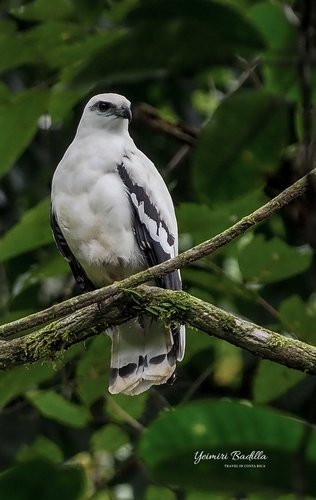
Adult white hawks (Leucopternis albicollis) measure 46–56 cm (18–22 in) in length, with very broad wings. They have white plumage on the head, body and underwings; their upper wings are black, and their very short tail is black with a broad white band. The bill is black, and the legs are yellow. The sexes have similar plumage, but females are larger and heavier: females weigh 840 g (1.85 lb), while males weigh 650 g (1.43 lb). Immature birds have extensive black spotting on the upperparts and dark-streaked whitish underparts. The call of the white hawk is a plaintive kerwee. This species lives in lowland forest and other types of woodland. Its range extends from southern Mexico through Central and South America to Peru, Bolivia, and Brazil, and it also breeds on Trinidad. In central South America, it occupies the entire Amazon basin, from the Andes in the west to the Guianas on the Atlantic in the northeast, and extending south to transition lands. It is a widespread species that is usually not common, but the IUCN considers it not globally threatened due to its large range. The white hawk feeds mainly on reptiles such as lizards and snakes (including the eastern coral snake). It also eats some insects (beetles and grasshoppers), crabs, amphibians, and mammals (including rats, squirrels, small opossums, and bats), catching prey in a sortie from a perch. Researchers have documented the white hawk feeding on multiple bird species, including the keel-billed toucan, mottled owl, white-breasted wood wren, and great tinamou. It may also feed on young and weak birds. Though rare, there is some evidence that this hawk may occasionally eat fish: a researcher in Suriname found fish remains in a white hawk's stomach. The white hawk associates with foraging groups of tufted capuchin monkeys (Cebus apella) and South American coatis (Nasua nasua) to catch prey that is startled by these animals. This species is often seen soaring, and performs a spectacular aerial courtship display. It builds a large stick platform nest in a tree, and usually lays one dark-blotched blue-white egg. An attended nest was observed in Ecuador in mid-August.