About Leucopogon microphyllus (Cav.) R.Br.
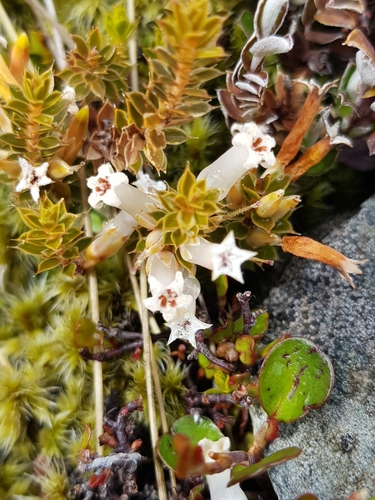
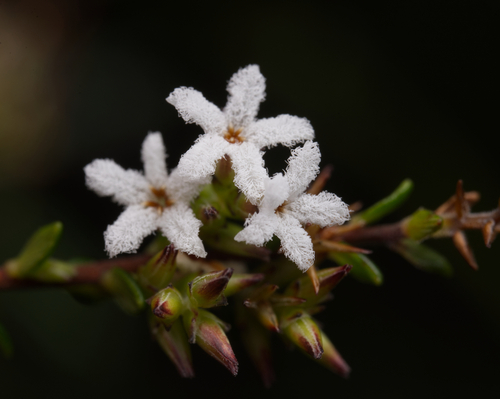
Leucopogon microphyllus (Cav.) R.Br. is a bushy or spreading shrub that usually grows up to 1 metre (3 feet 3 inches) tall. Its branchlets are covered in fine, bristly hairs. The leaves are egg-shaped, sometimes with the narrower end pointing toward the base. Each leaf is 2.2–7.3 mm (0.087–0.287 in) long and 1.4–2.5 mm (0.055–0.098 in) wide, attached to a petiole that is up to 0.5 mm (0.020 in) long. The leaves are more or less glabrous, with a convex upper surface, and a lower surface marked by roughly parallel veins. Flowers are arranged in erect spikes, most often holding 4 to 9 flowers, with the entire spike measuring 5–11 mm (0.20–0.43 in) long. Small bracteoles 1.3–1.8 mm (0.051–0.071 in) long are present at the base of each flower. The sepals are 2.3–2.7 mm (0.091–0.106 in) long. The petals are white, joined at the base to form a tube 1.1–1.8 mm (0.043–0.071 in) long, and have lobes 1.5–2.6 mm (0.059–0.102 in) long that are covered in soft hairs on the inside. Flowering can occur in most months of the year, but peaks from August to October. The fruit is an oblong drupe 1.2–1.5 mm (0.047–0.059 in) long. The autonym variety, Leucopogon microphyllus var. microphyllus, grows in heath and forest on ridges and hillsides. It is widespread across the coasts and tablelands of New South Wales and the Australian Capital Territory, and its range extends into south-eastern Queensland. This variety grows from sea level up to altitudes of 1,200 m (3,900 ft). The variety Leucopogon microphyllus var. pilibundus grows in open forest and woodland on ridges and rocky creek banks. It occurs in near-coastal areas and tablelands of New South Wales, the Australian Capital Territory, and north-eastern Victoria, with a separate disjunct population near Lerderderg Gorge. This variety grows at altitudes between 800 m and 1,200 m (2,600 ft to 3,900 ft).