About Leucopogon lanceolatus R.Br.
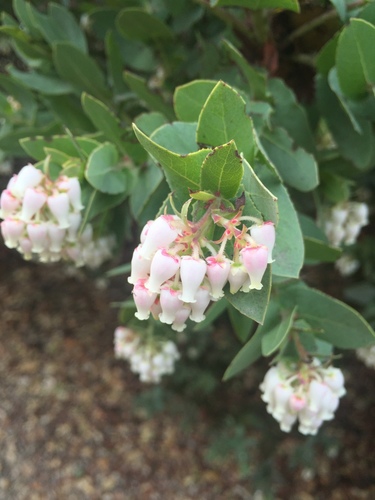
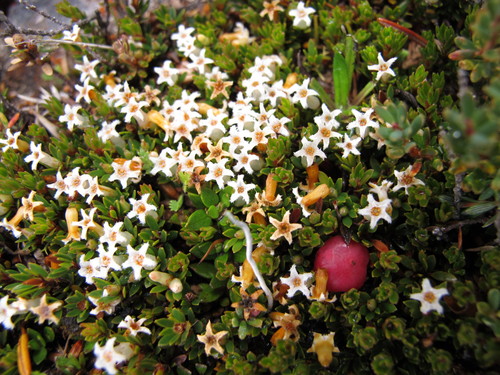
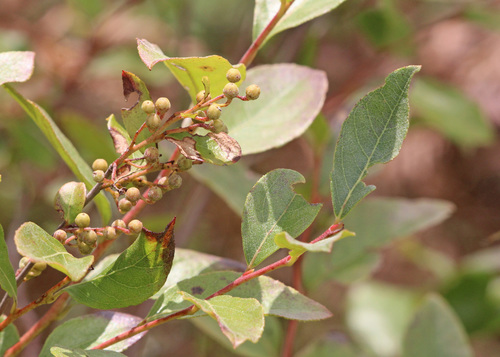
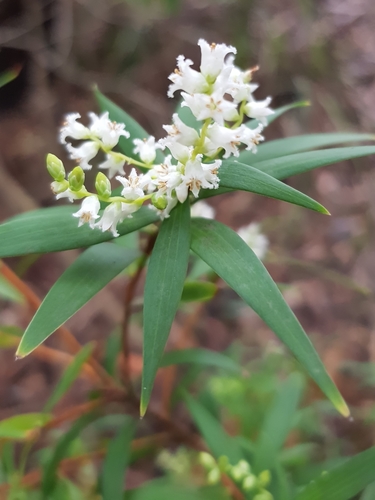
Leucopogon lanceolatus R.Br. (formerly described as Leucopogon affinis) is an erect, often bushy shrub that reaches 0.7 to 3 meters (2 to 10 feet) in height. Its youngest branches are sometimes covered in tiny hairs. The leaves are lance-shaped, elliptic, or egg-shaped, measuring 6 to 50 millimeters (0.2 to 2 inches) long and 1.3 to 8 millimeters (0.05 to 0.3 inches) wide. Leaves are almost stalkless, with a narrow base and a pointed tip. The lower surface has fine striations, and leaf edges sometimes have fine teeth near the tip. Flowers are arranged in spikes at the ends of branches and in upper leaf axils. Spikes are 3 to 39 millimeters (0.1 to 2 inches) long, holding between 2 and 16 tube-shaped white flowers. The flower tube is 3 to 4 millimeters (0.1 to 0.2 inches) long, with 5 pointed lobes that are densely hairy on the inside. Narrow, egg-shaped sepals 1 to 2 millimeters (0.04 to 0.08 inches) long surround the base of the flower tube. Flowering occurs from August to October, and is followed by a glabrous, edible, oval-shaped, reddish-orange fruit that is about 3 millimeters (0.1 inch) long. This species mainly grows in open forests and woodland, and sometimes grows in moist gullies or swampy areas across a range of soil types. It occurs in south-east Queensland, the coast and adjacent ranges of New South Wales, far south-eastern South Australia, and on some islands in Bass Strait, but does not grow on the Tasmanian mainland.