About Leucopogon australis R.Br.
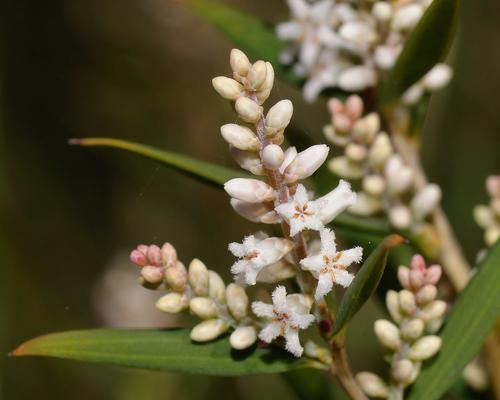
Leucopogon australis R.Br. is an erect, aromatic shrub that typically grows 1 to 2 meters (3 feet 3 inches to 6 feet 7 inches) tall, and has hairless branchlets. Its leaves are more or less hairless, and shaped from narrowly egg-shaped to narrowly elliptic. The leaves measure 10 to 85 millimeters long and 2 to 10 millimeters wide, and grow on a leaf stalk 0.6 to 1.5 millimeters long. Flowers are arranged in groups of 8 to 28, forming clusters 8 to 34 millimeters long. These clusters grow at the ends of branchlets or in upper leaf axils, and are accompanied by egg-shaped bracts 0.7 to 1 millimeter long, plus similarly sized bracteoles. The sepals are egg-shaped, 1.2 to 1.9 millimeters long, and yellowish. Petals are joined at their base to form a bell-shaped tube that is roughly as long as the sepals. The petal lobes are white, 2.3 to 2.7 millimeters long, and densely covered with beard-like hairs on the inner surface. Flowering occurs from September to November, and the fruit that develops is a flattened spherical drupe 1.8 to 2.2 millimeters long. This leucopogon grows as a forest understorey plant in wetter locations. Its distribution is limited to areas within 100 kilometers (62 miles) of the coast: between Gingin, Augusta and Albany in Western Australia; Peterborough and Yarram in Victoria; and northern Tasmania, where the species is rare.