About Leucopogon amplexicaulis (Rudge) R.Br.
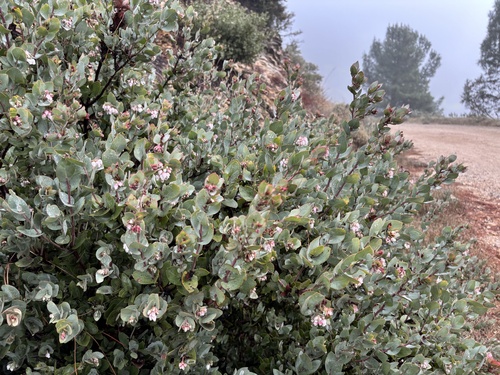
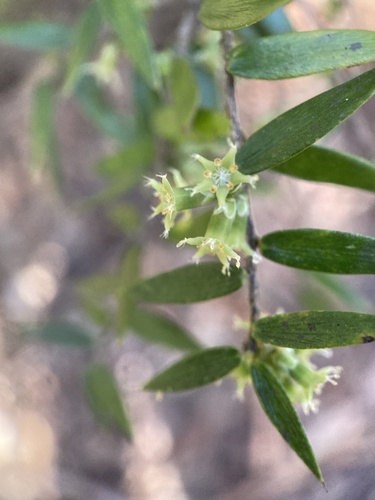
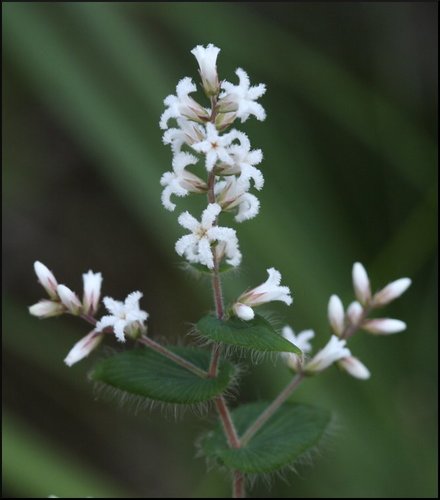
Leucopogon amplexicaulis (Rudge) R.Br. is a weak, scrambling or straggly shrub that typically reaches a maximum height of 90 cm (35 in). Its branchlets are covered in fine hairs. Leaves are egg-shaped and stem-clasping with a heart-shaped base, measuring 9.5–34 mm (0.37–1.34 in) long and 4.5–20 mm (0.18–0.79 in) wide, attached to a 1–2 mm (0.039–0.079 in) long petiole. Leaf edges are fringed, and the lower leaf surface is covered in soft or velvety hairs.
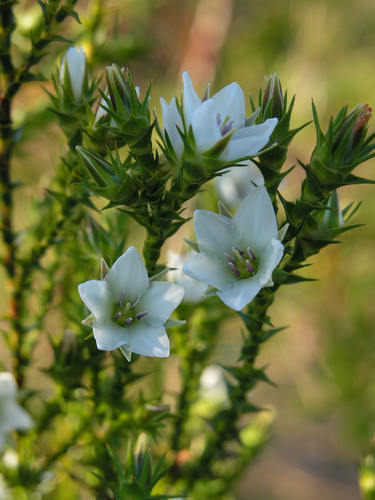
White flowers are arranged in groups of three to twelve along spikes up to 37 mm (1.5 in) long, and the spikes are longer than the plant’s leaves. Sepals are 2.1–3.1 mm (0.083–0.122 in) long, with 1.1–1.3 mm (0.043–0.051 in) long bracteoles at their base. The petal tube is 1.2–1.9 mm (0.047–0.075 in) long, and petal lobes are 1.2–2.6 mm (0.047–0.102 in) long, with soft hairs inside the petal tube. Flowering occurs from July to October, and is followed by a flattened, hairless drupe around 3.5 mm (0.1 in) long.
This species occurs from the Sydney Basin south to Shoalhaven on the New South Wales South Coast. It grows on sandstone soils in sclerophyll forest, in sheltered locations on sandstone outcrops and platforms, often near natural seepage. In the Sydney region, it is associated with trees including Sydney peppermint (Eucalyptus piperita), red bloodwood (Corymbia gummifera), and smooth-barked apple (Angophora costata), and with shrubs including heath banksia (Banksia ericifolia), coral fern (Gleichenia dicarpa), and dog rose (Bauera rubioides).
Individual plants have a lifespan of twenty to thirty years, and the species becomes more common in areas that have not been burnt by bushfire for a long time. Leucopogon amplexicaulis is killed by fire and regenerates from seed; seeds are thought to potentially be dispersed by ants.
Members of the genus Leucopogon are seldom cultivated, because propagation by seed or cuttings is difficult. When grown in gardens, Leucopogon amplexicaulis requires a well-drained site with ample moisture, a cool root run provided by large stones, and dappled shade, and grows well in humus-enriched, well-drained soil. It grows best in full sun, which keeps growth compact, and may benefit from light trimming. Seeds generally require scarification or prolonged soaking before propagation; the plant can also be propagated from layers or half-hardened tip cuttings. This species is mainly grown ornamentally in home gardens and public parks, is displayed in botanical gardens for educational purposes, and has decorative value for use in bouquets.