About Leucopholiota decorosa (Peck) O.K.Mill., T.J.Volk & Bessette
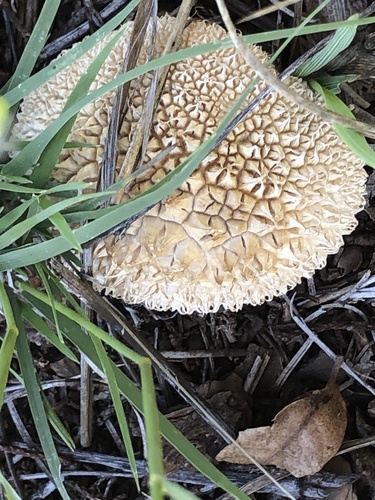
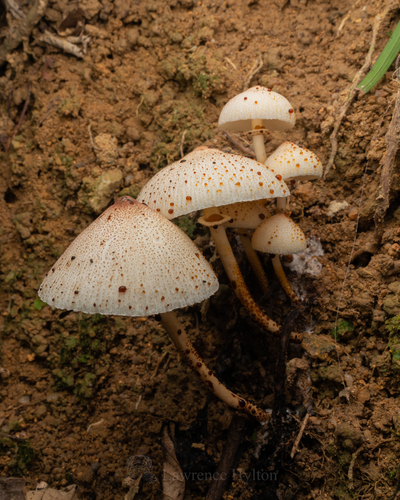
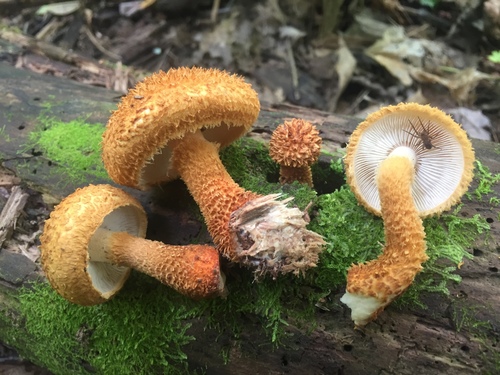
Leucopholiota decorosa caps start out conic or hemispherical, and expand to become convex or flattened when they reach maturity. Caps typically measure 2 to 6 cm (0.8 to 2.4 in) in diameter, and their surfaces are covered in many small, curved brown scales. The cap edge is usually curved inwards, and may have coarse brown fibers attached. The cap is cinnamon brown, with a darker color at the center. The gills are closely spaced, attach narrowly (adnexed) to the stem, and have finely scalloped edges. The stem is 2.5 to 7.0 cm (1.0 to 2.8 in) tall and 0.6 to 1.2 cm (0.2 to 0.5 in) thick. Like the cap, the stem is covered in scales from its base up to the annular zone, and is smooth above this zone. The partial veil is made of brown fibers that flare upward to form an annulus. The stem is roughly the same thickness along its entire length, or may be slightly thinner near the top. The flesh is white, thick, and firm in texture; it has no distinct odor, and its taste is either mild or bitter. The spore deposit of Leucopholiota decorosa is white. Spores are hyaline (translucent), roughly elliptical, thin-walled, and amyloid, meaning they absorb iodine stain in Melzer's reagent. When stained with acetocarmine, spores appear binucleate, meaning they have two nuclei. Spores measure 5.5–6 (more rarely 7) by 3.5–4.0 μm. Spore-bearing cells called basidia are club-shaped, translucent, and four-spored. Cheilocystidia, which are cystidia found on the gill edge, are club-shaped and measure 19-24 by 3–5 μm. The cap cuticle is a trichodermium, a tissue made of erect, long, threadlike hyphae of varying or equal lengths, that originates from an interwoven hyphal layer that gradually ascends until terminal cells are roughly parallel to each other. The trichodermal hyphae are thin-walled, measure 7.6–22.0 μm, and stain yellowish in Melzer's reagent. Hyphae that make up cap tissue are thin-walled and 5–10 μm in diameter. Gill tissue hyphae are also thin-walled, measure 3.5–7.0 μm, and are interspersed with oleiferous cells, which have strongly refractive, homogeneous contents. Clamp connections are present in hyphae of all tissues. Leucopholiota decorosa is a saprobic species, which gets its nutrients from decaying organic matter, especially rotting branches and stumps of deciduous trees. One field guide notes that it prefers sugar maple. It grows either singly or in clustered groups, with stems clustered together at the base. In Ohio, it typically fruits from late September to mid November. It is mostly distributed across eastern North America, and has also been collected in France. In 2007, it was reported from the Astore District of Pakistan, growing at an altitude of approximately 3,600 m (11,800 ft).