About Leucopaxillus albissimus (Peck) Singer
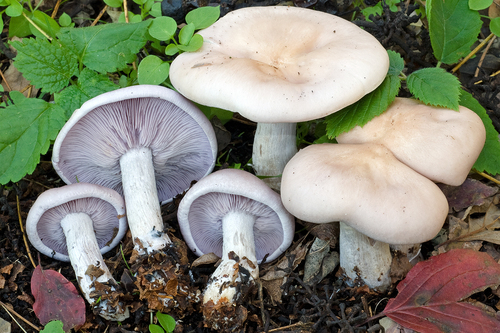
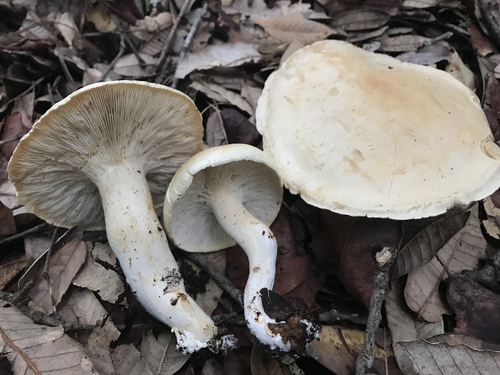
This species is generally white; its specific epithet albissimus means 'whitest' in Latin. Its cap ranges from 4 to 20 centimetres (1+1⁄2–8 in) wide, and can exceptionally reach up to 40 cm. The cap slowly changes shape from convex to plane, and occasionally has a depressed center. When young, the cap margin is incurved and faintly striate. The cap surface is dry, unpolished, and smooth; under moderate weather conditions, it becomes scaled and takes on a shade from cream to cream-buff. As the mushroom ages, the cap surface turns buff-tan. The flesh is overall white, moderately thick, and has a mild odor. The gills are crowded, broad, and decurrent. Though originally cream-colored, the gills turn buff-tan as they age. The stipe measures 3 to 7 cm in length and 2.5 to 4 cm in thickness; it is stout, and often enlarged at the base. The stipe surface ranges from smooth to finely scaled, and is cream-colored when young, and may turn buff-tan with age. When handled, the stipe base bruises pale buff-brown. The spore print is white. The elliptical spores are ornamented with amyloid warts, and measure 5–7 x 3.5–5 μm. This species has a tendency not to rot, and the biological reason for this trait is unknown. Leucopaxillus albissimus primarily grows under conifers and hardwoods, and often occurs scattered or gregariously in arcs or fairy rings. It fruits from mid to late winter in California, and in autumn in other parts of North America.