About Leucojum vernum L.
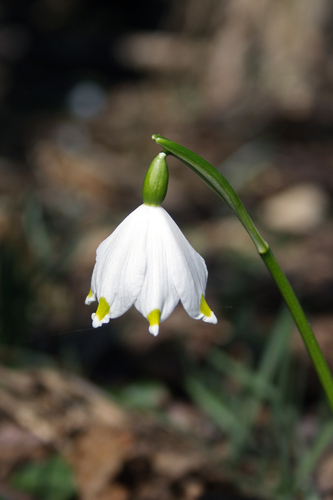
Leucojum vernum L. grows 12–35 cm (4.7–13.8 in) tall when in flower. Its leaves emerge alongside the flowers and continue to elongate through the flowering period; they are 5–25 mm wide and 10–25 cm (3.9–9.8 in) long, and typically extend only to below the height of the flowers. The flowering stem, called a scape, has a small central cavity and two narrow wings. The pendent flowers bloom in spring, and are most often solitary, rarely occurring in a two-flowered umbel. Each flower has six white tepals, each marked with a greenish or yellowish spot just below the tip. Individual tepals measure 15–25 mm in length. The whitish seeds of the species are around 7 mm long. Leucojum vernum is native to central Europe, as well as parts of southern and western Europe: specifically Austria, Belgium, the Czech Republic, Slovakia, Germany, Hungary, Poland, Switzerland, France, Italy, Romania, former Yugoslavia, and Ukraine. It has become naturalized in other regions, including other parts of Europe such as Great Britain, the Netherlands, and parts of Scandinavia, plus Georgia and Florida in the United States. It grows in damp, shady habitats including woodland, and can be found at elevations up to 1600 m. All species in the genus Leucojum are poisonous, because their leaves and bulbs contain the toxic alkaloids lycorine and galantamine. Galantamine is used to treat cognitive decline associated with mild to moderate Alzheimer's disease, and various other memory impairments. Leucojoum vernum is cultivated as an ornamental plant, valued for its spring-blooming white flowers. It is said to be easy to grow in full sun or partial shade, growing particularly well in moist soil and grassy areas. This species has been awarded the Royal Horticultural Society's Award of Garden Merit.