About Leucojum aestivum L.
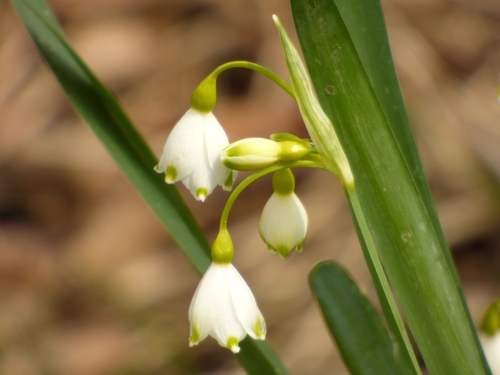
Leucojum aestivum L. is a perennial bulbous plant. It is generally 35–60 cm (14–24 in) tall, though some forms can reach 90 cm (35 in) in height. Its leaves are fully developed when flowering begins; they are strap-shaped, 5–20 mm (0.2–0.8 in) wide, and grow to roughly the same height as the plant's flowers. The hollow flowering stem (called a scape) has wings with translucent margins. Pendant flowers appear in late spring, borne in umbels that usually hold three to five flowers, and sometimes as many as seven. The flower stalks (called pedicels) vary in length, measuring 25–70 mm (1.0–2.8 in) long. The flowers are around 3–4 cm (1.2–1.6 in) in diameter, with six white tepals, each marked with a greenish spot just below its tip. Black seeds of this species are 5–7 mm (0.2–0.3 in) long. After flowering, developing fruits grow flotation chambers but stay attached to the plant's stem. Records from Britain note that flooding can break stems, carrying fruits downstream to become stranded in river debris or on flood-plains. Bulbs can also be moved during heavy floods and deposited on river banks.
Leucojum aestivum is native to most of Europe, excluding Scandinavia, Russia, Belarus, and the Baltic Republics. It is also native to Turkey, the Caucasus, and Iran. It has become naturalized in other areas: parts of Europe including Denmark, South Australia, New South Wales, Nova Scotia, and much of the eastern United States. This species grows in damp locations, such as wet meadows, swamps, and ditches.
All Leucojum species are poisonous, because their leaves and bulbs contain the toxic alkaloids lycorine and galantamine.
Leucojum aestivum is cultivated as an ornamental plant for its flowers. It needs a damp growing position, and grows well on clay soils, where it spreads rapidly. The cultivar 'Gravetye Giant' is a robust form that grows to 90 cm (35 in) tall, with up to eight flowers per scape. It is named for Gravetye Manor, an Elizabethan manor house in West Sussex, England that was formerly the home of gardener William Robinson. This cultivar has earned the Royal Horticultural Society's Award of Garden Merit. A second cultivar is 'Nancy Lindsay'. It is shorter and more compact than 'Gravetye Giant', reaching 50–60 cm (20–24 in) tall, and produces 5–6 flowers per stem, with rounder, broader tepals. It originated in a garden in southern France owned by Nancy Lindsay.