About Leucocrinum montanum Nutt. ex A.Gray
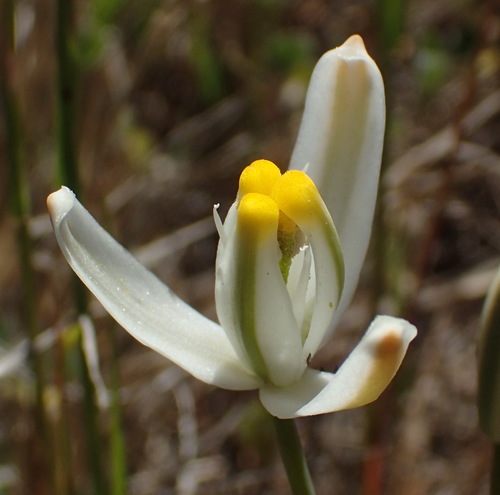
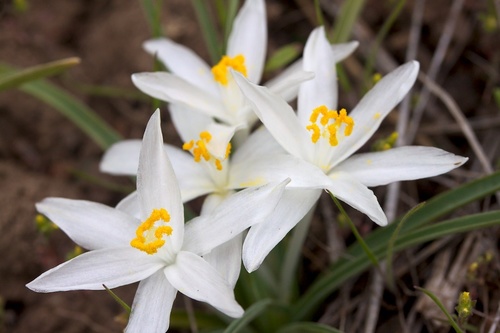
Leucocrinum montanum Nutt. ex A.Gray, commonly known as common starlily, is a small herbaceous plant that reaches just 5 to 10 centimeters (2 to 4 in) in height. Plants grow as a stemless tuft of narrow, hairless, grass-like leaves that reach 10–20 cm (4–8 in) long and only 2–8 millimeters wide. Leaf edges are slightly white, and leaves have a U-shaped cross section. The base of each leaf tuft is surrounded by a membranous sheath. Underground, the plant has a short caudex, also called a crown, that is usually around 5 cm (2 in) under the soil surface. Its roots grow as fleshy strings from a central point, and are light gray to tan in color. Common starlilies are geophytes, which avoid unfavorable conditions by dying back to their fleshy roots for most of the year, with leaves disappearing by early summer. It is one of the best known early spring wildflowers of the Rocky Mountains. Its flowers are stemless, like its leaves, and grow from an underground umbel-like flower stalk. There are often four to eight snowy white flowers per cluster, each with six tepals: three nearly identical narrow, pointed petals and sepals that spread outward to resemble a star. The tepals are translucent or crystalline rather than waxy, and thin tepals glisten in sunlight. Each tepal measures 2 to 2.5 cm (0.8 to 1 in) long and just 3–7 millimeters wide. The bases of the tepals fuse into a long tube that attaches to underground plant parts. The floral tube is 4 to 10 cm (1.6 to 3.9 in) long, typically 5 to 8 cm (2.0 to 3.1 in) in length. Six thread-like stamens attach near the top of the tube, with an exposed portion shorter than the tepals. Each stamen is topped with bright yellow pollen. The species is dimorphic in pollen production, with two distinct pollen forms found in separate populations. Flowers produce an intense, sweet fragrance. Blooming can occur as early as March or as late as June. March warmth triggers earlier blooming, while May and June precipitation extends the duration of blooming. The fruit is a three-sided capsule that also grows underground, so it is seldom seen. It measures around 5–8 mm. Each capsule holds a few to several black, angled seeds approximately 3 to 4 mm in size. William Weber and Ronald C. Wittmann note that the stalk attaching the capsule lengthens as it matures, so seeds end up just under the soil surface to be pushed up by the next year’s emerging flowers. However, J.G. Lemmon reported in 1877 that when leaves dry out and blow away, their in-curved bases carry the seed capsules away. In the 2006 book Dakota Flora, botanist Dave Ode suggested that ants or other insects dig up and distribute the seeds. Common starlily grows across much of the western United States, with an estimated range of 200,000–2,500,000 square kilometers (77,000–965,000 sq mi). The eastern edge of its range stretches from North Dakota to New Mexico in shortgrass prairie. In North Dakota, the USDA Natural Resources Conservation Service PLANTS database (PLANTS) records it only in two southwestern counties; it grows through much of the southern two-thirds of Montana, and reaches as far north as Flathead County. In Wyoming, it mostly grows in the eastern half of the state, and also grows in Park County in the northwest. In South Dakota, it grows only in the westernmost portion of the state, just as it does in neighboring Nebraska. In Colorado, it grows in most of the eastern plains, and also in some mountain and western counties. In New Mexico, it is only found in a few areas in the northern part of the state. The western part of the common starlily's range crosses the Rocky Mountains, and extends across much of the Great Basin into the surrounding Intermountain West. According to PLANTS, in Arizona it is only found in Mohave County. It is also limited to four counties in southern Utah, and four counties in southwestern Idaho. However, it grows in almost all of Nevada, and large parts of Oregon east of the Cascades, plus Josephine County. In California, it grows from the Klamath Basin east to the Modoc Plateau in the northeast of the state. Common starlily grows at elevations from 800 meters (2,600 ft) up to 2,400 m (7,900 ft). In terms of ecology, common starlily is a minor food source for the eastern deer mouse on Colorado prairies, making up less than 1% of their diet in one study. North American little black ants visit flowers to collect pollen, and flowers are also visited by honey bees. The blister beetle Epicauta parvula has been observed eating flower petals and leaves, and the grasshopper Spharagemon equale also eats the leaves. As caterpillars, generalist white-lined sphinx moths (Hyles lineata) sometimes eat the leaves. Though it is not a major component of grasslands, grazing cattle have a moderate preference for its leaves. Like cool-season grasses and sedges, it is found in higher numbers on rangelands grazed at low intensity rather than high intensity. In contrast, an experiment with captive pronghorns found they only consumed trace amounts of common starlily when it was available. The disease-causing rust species Puccinia sporoboli infects common starlilies. One Northern Paiute person interviewed at the Duck Valley Indian Reservation around 1940 reported using ground roots, which developed a soapy texture, to heal sores or swellings. In 1890, botanist J.W. Blankinship recorded that the Crow people of Montana ate the roots. For cultivation, wildflower writer Claude A. Barr notes that while common starlilies require well-drained soil, they do not need fully sandy soil as their name might suggest. He recorded that they perform best in firm clay, sandy clay loam, or gravelly clay low in organic matter. Other writers report good growth in well-drained sandy or gravelly loam that is warm and only slightly rich, planted in full sun with dry conditions. The critical period for the plants is from their late spring dormancy until they begin growing in late winter; excessive rain during summer or fall is harmful to plants. They cannot compete with taller garden plants. Their leaves disappear soon after flowering, so they are planted alongside annuals or plants that leaf out later. Moving dormant plants causes the least damage when done in fall. A common starlily that has been moved or divided usually does not bloom the next year, or sometimes even the year after. Colorado State University Extension rates this as one of the least flammable native plants, suitable for landscaping around homes and structures in wildland–urban interface areas.