About Leucocoprinus tricolor H.V.Sm.
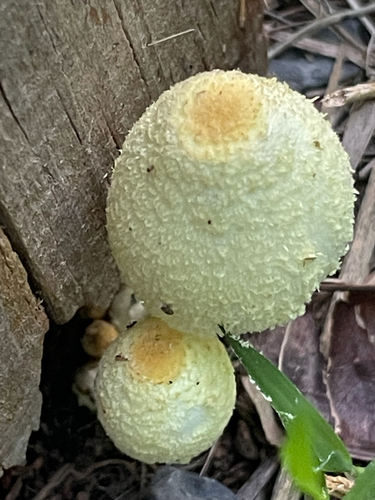
Leucocoprinus tricolor is a small dapperling mushroom with thin pale yellow flesh. Its cap ranges from 1.6 to 6 cm wide; it starts ovate, campanulate, or conical, then flattens as it matures, usually with a distinct umbo that may occasionally be absent. When young, the cap surface is covered in woolly floccose or squamulose scales. Scales at and around the umbo are greyish brown, while the rest of the cap and its covering scales are pale yellow. In immature specimens, the umbo may be orange-yellow, before turning brown and smoothing out with age. The cap edge has distinct grooves or striations, which can appear striate, plicate, or sulcate. Cap flesh is very thin, flexible, dry to the touch, pale yellow, and does not change colour when damaged. The gills are crowded, free from the stem, pale yellow, and very thin. The stem is 1.5–8 cm long, 2–6 mm thick at the top, and 6–11 mm thick at its bulbous base. It is mostly smooth, or sometimes has fine scales near the top and woolly tufts lower down. The top of the stem is lemon yellow, while the base is golden yellow; lower stem scales carry an orange tinge, and sometimes turn greyish-brown when damaged or handled. Stem flesh is also pale yellow. A small, thin, membranous yellow stem ring is present, and it disappears quickly. Spores are ellipsoid to subglobose with a small germ pore, measuring 8–11 x 7.2–9 μm. The taste is indistinct, with a dry, cotton-like texture. The odour is strong and pungent, similar to that of the stinking dapperling Lepiota cristata, which is described as having an unpleasant rubbery or fishy smell. When specimens are dried, the umbo or cap centre turns greyish brown, while the rest of the cap stays pale yellow, and the stem base becomes orange or cadmium orange. Occasionally, specimens do not develop the distinct three-colour effect, remaining roughly uniform in colour, but gaining a grey or tan tint. Grey discoloration rarely occurs when specimens are bruised or dried. This species is scarcely recorded and little known. The originally studied specimens were collected from greenhouses at the University of Michigan Botanical Garden in 1975, with additional specimens found growing in plant pots filled with either soil or bark in subsequent years. The mushrooms grow singly or in clusters. Because botanical gardens host exotic plants from across the globe, the original study could not confirm where this species originated or is native to.