About Leucocoprinus cretaceus (Bull.) Locq.
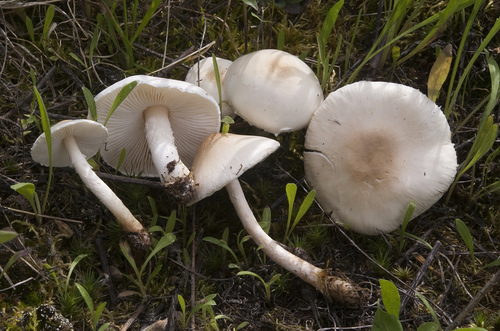
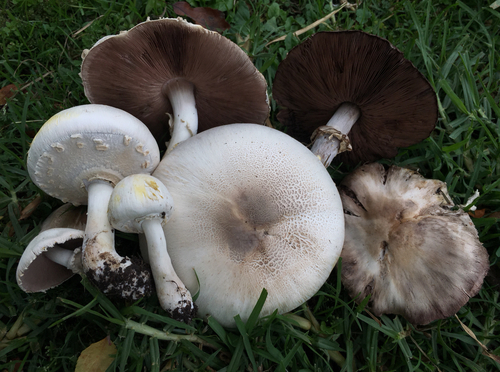
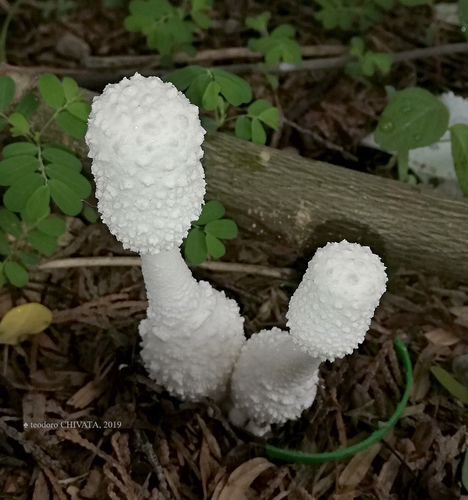
Leucocoprinus cretaceus is a small dapperling mushroom with white flesh and a distinctively warty cap. The cap measures 2–8 cm across; it is bulbous when immature, becoming convex or flat with age and growth. It is stark white and covered in warts. The stem is 3–8 cm tall and 5–10 mm thick, tapering upwards from a swollen base that may bear similar warty scales, and it has a fragile stem ring. The gills are white, free, and crowded. The spore print is white to creamy white. Spores are subamygdaliform or ellipsoid, smooth with a small pore, and dextrinoid, measuring 6–12 x 4–7 μm. The smell is indistinct.
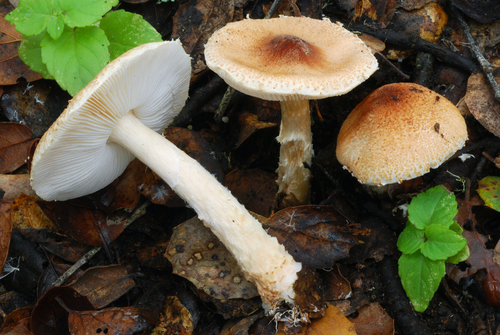
Flora Agaricina Neerlandica provides more detailed observations: The cap is 3.8–9 cm wide, starting hemispherical, convex, or conico-convex before expanding and flattening with age to become plano-concave, with or without a slight umbo. The cap surface is white, covered in woolly warts and scales (floccose squamulose), and has a brownish yellow tinge at the cap centre. Gills are white to very pale cream, free and remote from the stem, crowded, and very thin. The stem is 2.8–11 cm long and 2–13 mm thick, with a bulbous clavate or fusiform base that is 7–19 mm thick. The stem interior is solid when young, becoming stuffed with age; the exterior surface is white, developing a slight brownish yellow colour with age, more prominently in the top half. Above the ring, the stem surface is covered in a minute flocculose or felty coating, while thicker warts are present below the ring and towards the base. The easily brushed off coating reveals that the stem surface discolours yellowish when bruised. The ring is located halfway up the stem (median), starting flared before becoming pendulous; it is 5–10 mm wide and thin, with a felt-like or submembranous texture, smooth on the upper surface and covered in a minute flocculose coating on the underside. The spore print is whitish to cream. Spores measure 8–12 x 5.5–7.5 μm, with an average range of 8.7–10.5 x 5.9–6.8 μm. They are ellipsoid to oblong or slightly amygdaliform with a thick wall and germ pore, and are dextrinoid, congophilous, and cyanophilous, with a pink interior when stained with cresyl blue. Basidia are 4-spored and measure 18–28 x 8.5–12 μm.
In terms of habitat and distribution, Leucocoprinus cretaceus has been documented growing in plant pots and greenhouses, so it may have a worldwide distribution in cultivation, and introduction into the wild is possible in locations with temperatures suitable for this tropical species. In a 1907 study, American mycologist Andrew Price Morgan documented this species (then classified as Lepiota cretacea) growing in rich garden soil and in hot beds throughout North America. It is widespread in tropical areas, with a scattered distribution in South America. Five Leucocoprinus species collected recently in Northern Argentina and Paraguay were identified: four of these, including L. cretaceus, were reported for the first time in Paraguay, and later three of the other species were reported in northeastern Argentina.