About Leucocoprinus cepistipes (Sowerby) Pat.
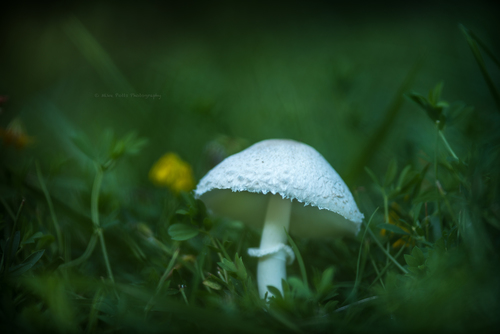
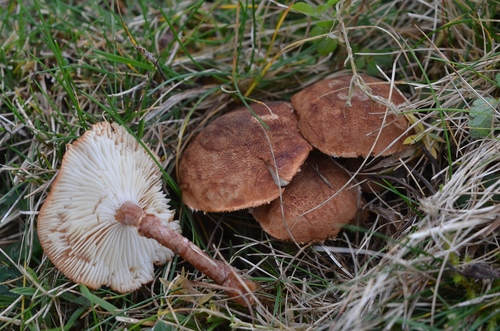
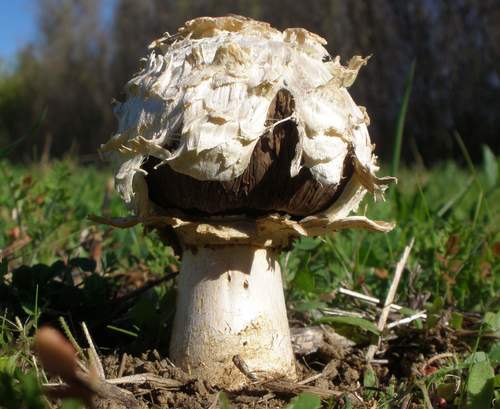
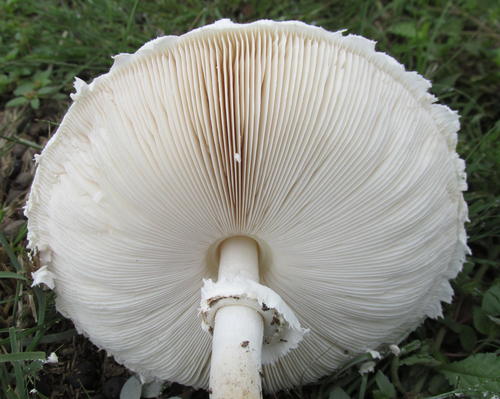
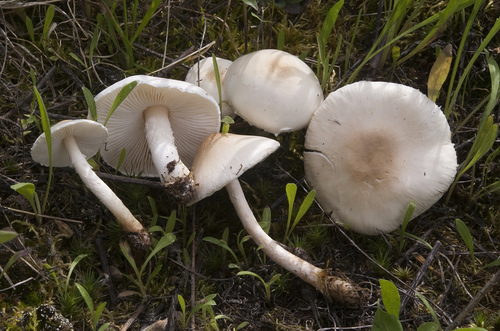
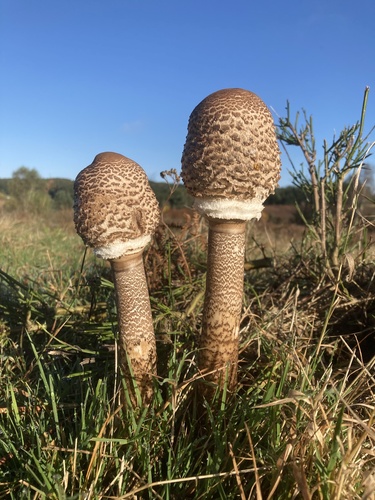
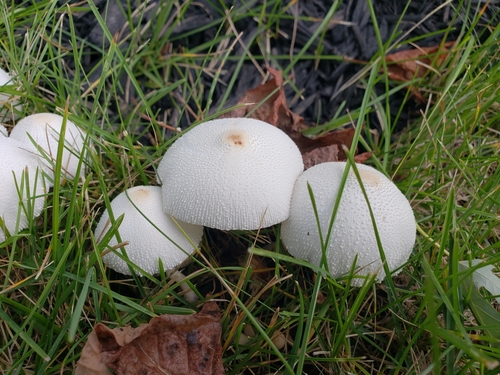
Leucocoprinus cepistipes is a small dapperling mushroom with white flesh. Two sets of morphological measurements and details have been documented for this species. For the cap, the first description notes it reaches 3–9 cm across. It is bulbous when immature, becoming convex with a prominent umbo that is often darker at the centre, while the rest of the cap surface is white. The second description notes the fully expanded cap reaches 3–6.5 cm wide: it starts paraboloid, expands to campanulate, then flattens. When immature, the cap surface is brown with brown scales clustered most densely towards the centre. As it expands, the surface becomes white or creamy, with brown colour remaining only at the centre. It develops yellow bruising when touched, and has sulcate striations at the cap margins. For the stem, the first description says it is 6–9 cm tall and 4–10 mm thick, slightly bulbous at the base, with a stem ring that may disappear quickly, and may discolour slightly yellow or pinkish brown. The second description notes the stem is 3–13 cm long and 2.5–5 mm thick, wider at the base, tapering upwards, with a hollow interior. The entire stem surface has a dense, fine pubescent coating. It is white when immature, becoming cream to brownish-cream with age. When young, it bruises yellow; when a mature stem is damaged, it bruises yellow-brown to brown. When immature, it exudes clear drops that may coat the stem surface. The ascending stem ring is white when young, with yellow exudation and some thick scales at the margin similar to the scales on the cap; it is evanescent and often disappears. Small scales are present on the stem below the annulus. For the gills, the first description notes they are white, sometimes discolouring to pinkish brown with age, are free and crowded. The second description states they are crowded, free, and remote from the stem with a collar. They are cream to pale brownish cream, discolouring brown with age, and retain a white fimbriate or floccose edge when viewed with a lens. Flesh is white in the cap and stem of young specimens, turning cream coloured with age. Smell is recorded as indistinct in the first description, or fruity, soapy, or similar to Lepiota cristata when cut in the second. Taste is rubbery. Spore print is white. The first description records spores as ellipsoid and smooth with a tiny pore, dextrinoid, and measuring 7–11 x 4–7 μm. The second description records spores ranging 7.5–13 x 6–8 μm, with an average size of 8.5–11.1 x 6.6–7.5 μm. In side view spores are ellipsoid, oblong or amygdaliform, and ellipsoid to oblong in face view. They have a thick wall with a germ pore, and are dextrinoid, congophilous and cyanophilous. When mounted in Cresyl blue, they have a pink inner wall. Basidia measure 16–37 x 8–12 μm, are mostly 4-spored, and rarely 2-spored. Cheilocystidia measure 25–60 x 8–15 μm, and are clavate or lageniform. This species is most commonly reported from greenhouses and hothouses, and is especially noted for growing in bark beds. In 1867, Belgian botanist Jean Kickx documented Agaricus cepaestipes growing in tanbark in the greenhouses of the Ghent Botanical garden during summer.