About Leucocoprinus brunneoluteus Capelari & Gimenes
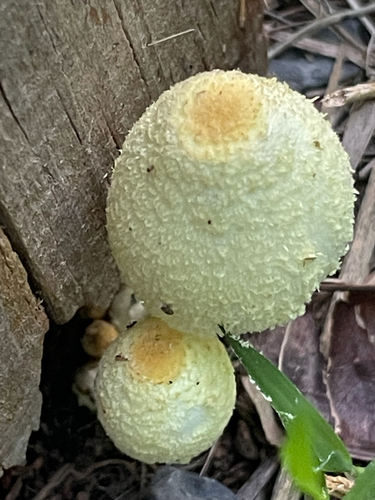
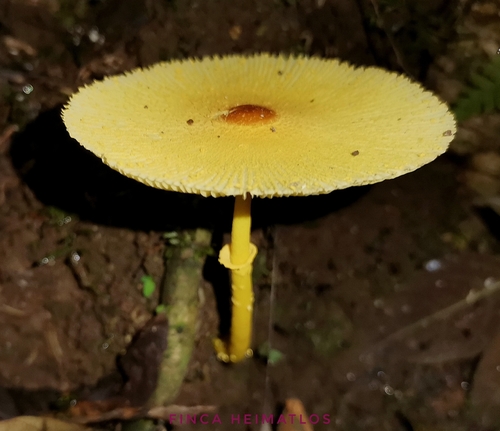
Leucocoprinus brunneoluteus is a small dapperling mushroom with thin yellow flesh. It is superficially similar to Leucocoprinus birnbaumii, but can be distinguished by its more distinctly pronounced brown umbo. The cap ranges from 1.2 to 4.5 cm wide. It is subconical when immature, expanding to convex, and finally becomes planar with slightly uplifting cap margins and a pronounced dark brown umbo. The rest of the cap surface is bright yellow, covered in dark brown scales that grow sparser further from the umbo and closer to the cap edges. Plicate-striate striations extend from the cap margins almost to the central disc. The stem is 3.5 to 9 cm tall and 2 to 7 mm thick, with a slightly bulbous base and tapering toward the top. The stem surface shares the same yellow hue as the cap and gills, and its interior is hollow. A yellow-brown stem ring is located towards the top of the stem (superior), though it may disappear as the mushroom matures. The gills are free and remote from the stem, crowded, and yellow. This species produces a white spore print. Spores are elliptical to ovoid with a germ pore, dextrinoid, and measure 10-12 x 7-9 μm. In addition to its distinct dark brown umbo, L. brunneoluteus differs from L. birnbaumii by its more membranous texture, which is similar to the very thin-skinned, fragile Leucocoprinus fragilissimus. L. brunneoluteus has been documented in South America. The specimens originally studied by Capelari and Gimenes were collected from a state park near São Paulo, Brazil, where the mushrooms were found growing on the ground under pine trees.