About Leucocoprinus brebissonii (Godey) Locq.
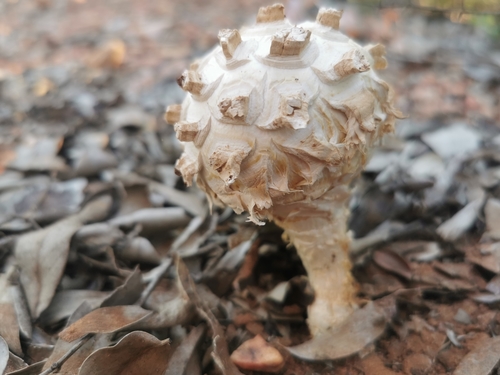
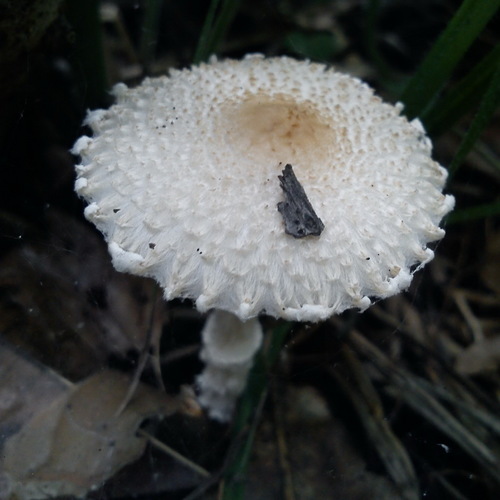
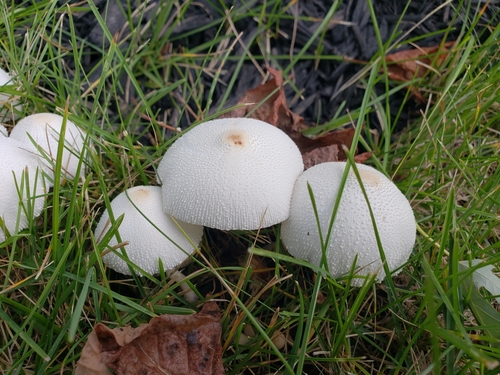
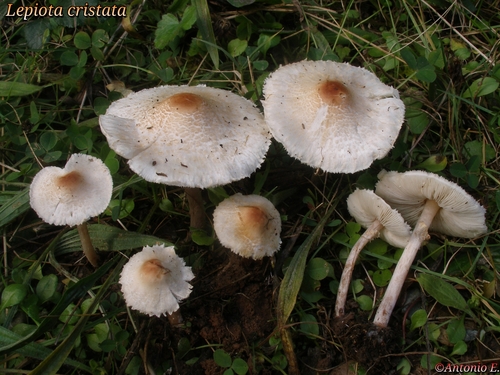
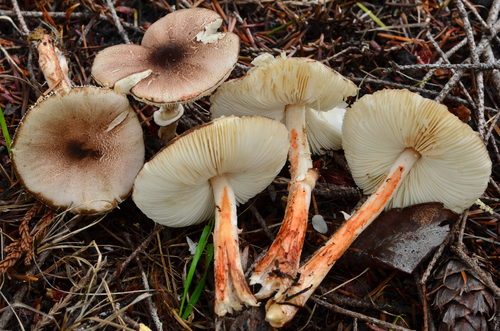
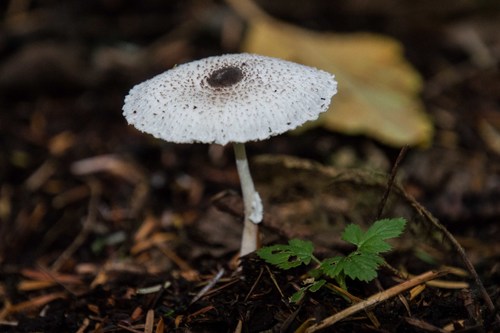
Leucocoprinus brebissonii is a small, delicate mushroom species with thin, brittle white flesh that tends to split along the edges of its cap. The cap ranges from 2 to 3cm wide; it starts out hemispherical or bulbous, then flattens as it ages, and features a small, often quite shallow dark brownish umbo. When young, the cap surface can be darker and brownish, but as the cap opens, this brown colouration breaks up and the surface lightens to white, with fine brown scales radiating out from the centre. These scales are largely absent closer to the cap edges. Distinct deep striations or grooves extend from the cap edges to roughly halfway up the cap surface, or almost all the way to the central disc. The gills are free, crowded, and white. The stem grows 3–7cm tall and 3–6mm thick; it is roughly equal in thickness along its entire length, or tapers slightly toward the base. The base may be bulbous, but this swelling is typically less pronounced than what is seen in other Leucocoprinus species. The stem surface is smooth and white, but may develop a light brownish tint with age. A small, movable stem ring is usually positioned in the middle or upper section of the stem, but this ring is fragile and often peels away or disappears entirely. This species produces a white spore print. Its spores are ellipsoid to amygdaloid, have a germ pore, test dextrinoid, and measure 8.5–10.5 by 5.5–6.5 μm. Both the smell and taste of Leucocoprinus brebissonii are indistinct. Leucocoprinus brebissonii occurs in Europe and North America, where it can be found growing in soil in deciduous woodlands from summer through fall. In 1874, Godey documented the species (then named Lepiota brebissoni) growing in Cerisy Forest, located in the Calvados region of France, during the summer. Godey noted that the fungus was solitary and rare.