About Leucocoprinus birnbaumii (Corda) Singer
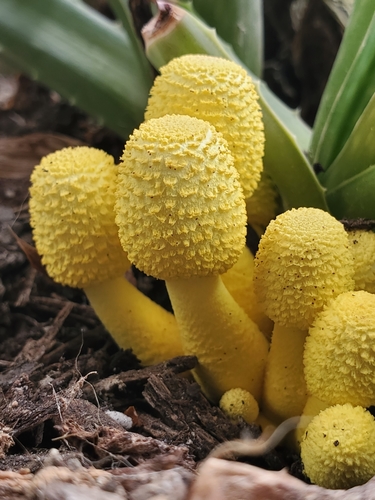
Leucocoprinus birnbaumii is a small, yellow dapperling mushroom. Its fruit bodies are agaricoid (mushroom-shaped) and grow singly or in small clumps. When mature, the cap is 2.5–6 cm wide; it starts out bulbous to cylindrical, then expands to hemispherical or conical before flattening, and sometimes develops an umbo with age. The cap surface ranges from lemon yellow to sulphur yellow, and is either smooth or slightly powdery. It is covered in easily removed ragged, fibrous scales that become darker yellow or brownish with age; scales are denser toward the center cap disc, often forming a patch, and sparser at the cap edges. The cap edges are sulcate-striate (striated and grooved), with a paler color in the grooves. When young, the cap edges curl inward, before curving outward or straightening with age. Cap flesh is firm when young, becomes softer and more fragile with age, and is dull whitish in color. The gills are free and often quite remote from the stem, are sulphur yellow, and vary in spacing from crowded to subdistant, reaching up to 4mm wide. With age, gills may become ventricose (bulge in the middle) and their edges may be fringed. The stem is 3–10 cm long, 1.5–5 mm thick at the top, and tapers to a bulbous or club-shaped base that is 4–15mm thick. The stem interior is hollow but pithy, with a shiny white color, while the exterior surface is lemon yellow to sulphur yellow and may discolor brownish with age. Fine powdery or woolly scales (pruinose to floccose-squamulose) cover the full length of the stem, starting just above the base. A thin, membranous stem ring can be located anywhere from the upper to lower sections of the stem, is movable, has a yellow top surface and whitish underside, but is evanescent and may disappear entirely. This species produces a white spore print. Spores are ellipsoid to amygdaliform with a large germ pore, are dextrinoid, and average 7.7–10.5 x 5.9–7.3 μm in size. The smell is indistinct, or occasionally mushroomy, and the taste is indistinct. When dried, the mushroom may discolor tan or brownish; this same brown color appears in aborted mushroom pins that fail to grow. Like all species in the genus Leucocoprinus, L. birnbaumii is a saprotroph that feeds on heavily decayed plant matter (humus or compost). The fungus is common throughout the tropics and subtropics, and extends into warmer parts of temperate zones. It rarely appears in cooler areas, with fruit bodies recorded as far north as England, but these occurrences are thought to be temporary introductions. In regions including North America, Europe, and Australia, it is more often found in hothouses and plant pots than in the wild. Observations on iNaturalist show this mushroom is most commonly spotted in summer, with a peak in July or August; while observations on the site are not always reliable due to misidentification, this seasonality is expected for a tropical species introduced to temperate climates. A 1907 study by American mycologist Andrew Price Morgan documented Lepiota lutea growing in greenhouses in Columbus, Ohio. A 2019 study documented L. birnbaumii growing from the stump of a dead lemon tree in an orchard near Damietta, Egypt during autumn. Leucocoprinus birnbaumii is a toxic mushroom. Consumption causes gastroenteritis-like symptoms. North Carolina State University classifies the species as having medium severity poison characteristics, while the University of Massachusetts Amherst states that its level of toxicity is currently unknown.