About Leucochrysum albicans (A.Cunn.) Paul G.Wilson
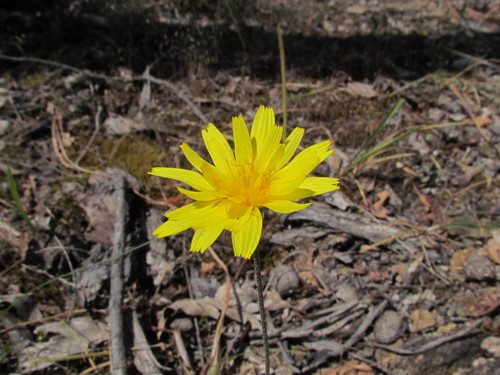
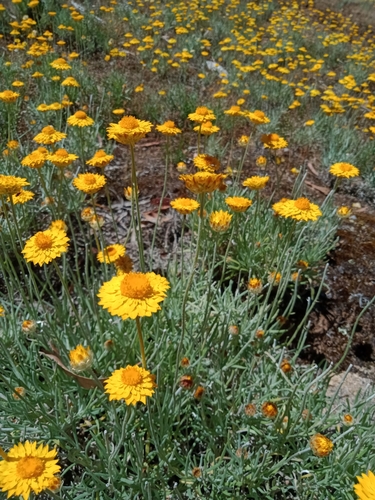
Leucochrysum albicans, commonly known as hoary sunray, is an upright, tufted perennial herb that grows up to 45 cm (18 in) tall. Its leaves are crowded near the base of the stems, range from linear to oblong or broadly egg-shaped, have a woolly texture, measure 2–10 cm (0.79–3.94 in) long and 1–9 mm (0.039–0.354 in) wide, and are light grey in color. Flower heads are 2–4 cm (0.79–1.57 in) in diameter, borne singly on a slender peduncle 7–15 cm (2.8–5.9 in) long. The outer bracts are brown, while inner bracts are arranged in rows and are white or yellow; the bracts are shaped triangular to narrow-elliptic, with a woolly leaf blade at their base. Flowering takes place in spring and summer. The fruit is an achene 3 mm (0.12 in) long, covered in feathery white bristles. This is a widespread species that grows in moist, rocky alpine sites, as well as woodlands and grasslands on nutrient-poor soils, across New South Wales, Victoria, Queensland and Tasmania. The subspecies tricolor mainly grows in grassland or grassy woodland at altitudes between approximately 100 and 900 m (330 and 2,950 ft), occurring in disjunct populations in Tasmania, Victoria and south-eastern New South Wales. No records of this subspecies have been made in Victoria during this century.