About Leucinodes orbonalis Guenée, 1854
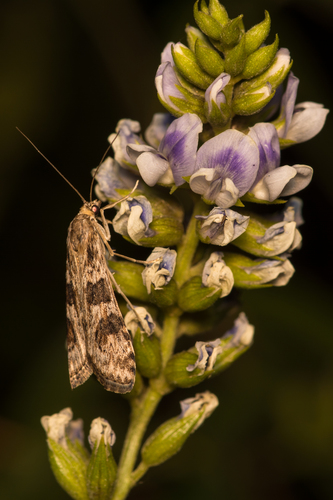
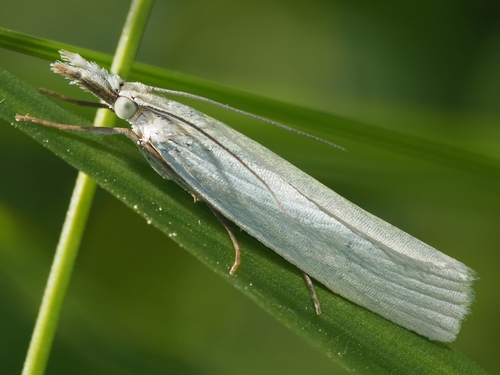
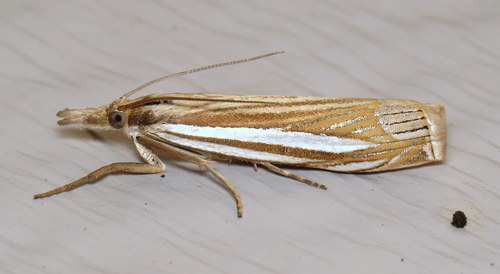
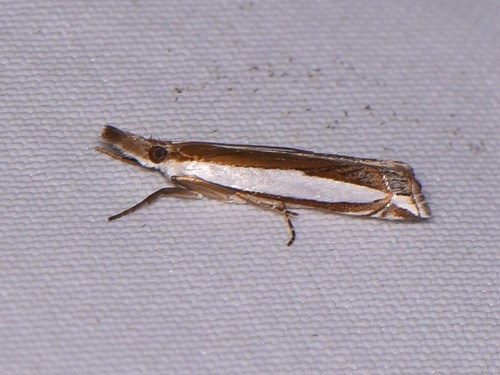
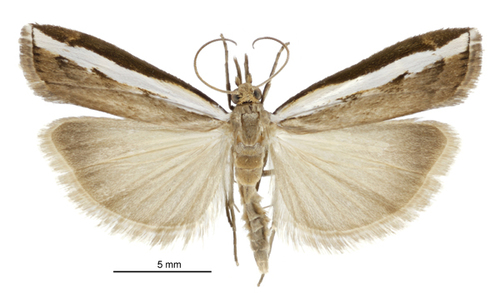
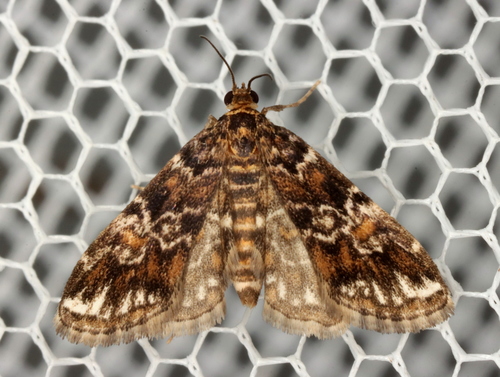
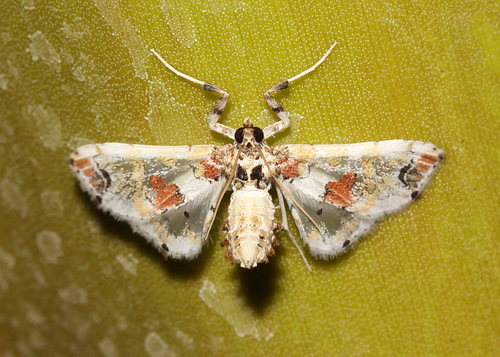
Leucinodes orbonalis Guenée, 1854 adults (imagines) show sexual size dimorphism: forewing length ranges 8.5–10.5 mm in males, and 9.5–12 mm in females. The forewing has a white ground color, with a basal area that ranges from light to dark brown, bordered by a dark brown to grey antemedial line. The median area bears a faint, pale brown proximal discoidal stigma, while the pale brown distal discoidal stigma extends from the costa to the center of the forewing. A prominent orange to dark brown L-shaped or triangular spot on the central dorsum extends toward the center of the forewing, and often connects to the distal discoidal stigma. The antemedial line is sinuate, more or less distinct, and features a prominent subcostal bulge. The subapical half of the termen has a half-moon shaped brown to grey-brown spot, and the marginal line is dotted. The hindwing has a white ground color. Its internal area is white, with a discoidal spot, and often an auxiliary spot near the base of the costa. The medial line is sinuate: its distal half approaches the discoidal spot, then turns toward the dorsum. The external area is pale brown to grey, with a dotted marginal line. The primary larval host plant of this species is eggplant (also called brinjal, Solanum melongena), where this moth causes nearly all of its documented economic impact. Secondary recorded larval host plants include tomato, potato, nightshade, Sodom apple, Ethiopian nightshade, potatotree, nipplefruit, black nightshade, turkey berry, tropical soda apple, Solanum anguivi, Solanum xanthocarpum, cape gooseberry, and Physalis minima. Females lay eggs at night on the lower surface of young leaves, green stems, flower buds, or fruit calyces. Within one hour after hatching, caterpillar larvae bore into the nearest tender shoot, flower, or fruit. Immediately after entering shoots or fruits, larvae plug the entrance hole with their own excreta. In young plants, caterpillars have been recorded boring inside the petioles and midribs of large leaves, which can cause affected leaves to drop off. When larvae feed inside young shoots, the shoots wilt, then eventually drop off. This damage disrupts plant growth and reduces the number and size of fruits produced. While plants may grow new replacement shoots, this delays overall crop maturity. When larvae feed inside fruits, they destroy fruit tissue, making even lightly damaged fruits unfit for commercial sale. A genetically modified eggplant variety, called Bt brinjal, has been developed to control damage from L. orbonalis. Multiple integrated pest management strategies have also been suggested to combat this pest, including use of sex pheromones, physical and mechanical barriers, cultural practices, bio-pesticides, biological control agents, botanical pesticides, and less hazardous chemical pesticides.