About Leucauge mariana (Taczanowski, 1881)
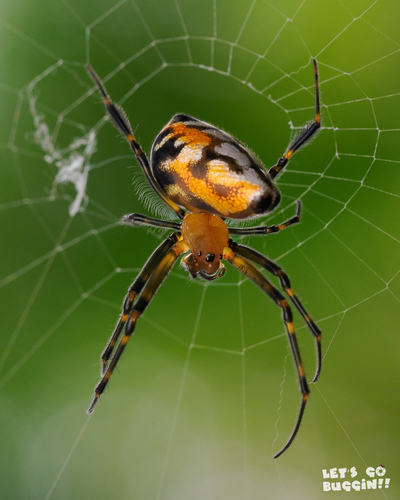
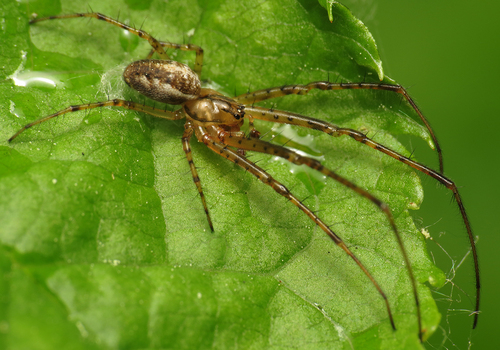
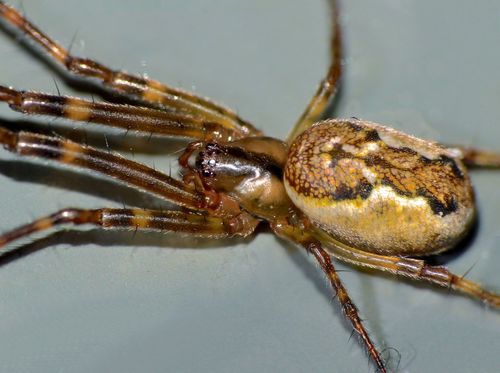
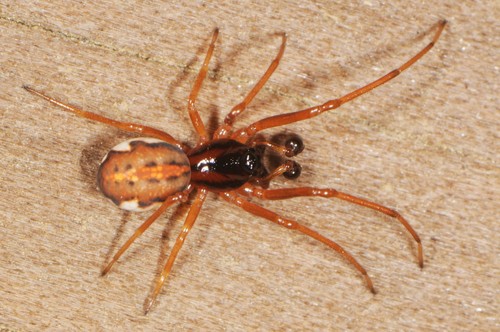
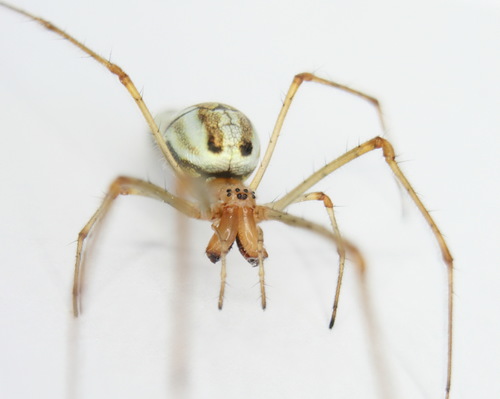
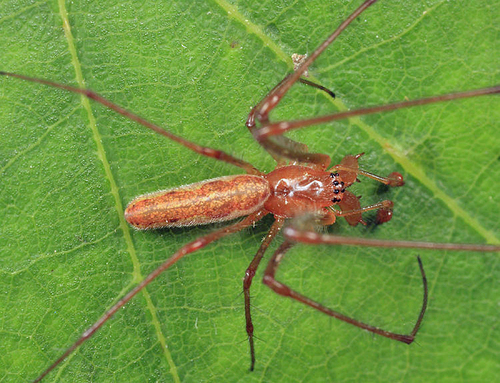
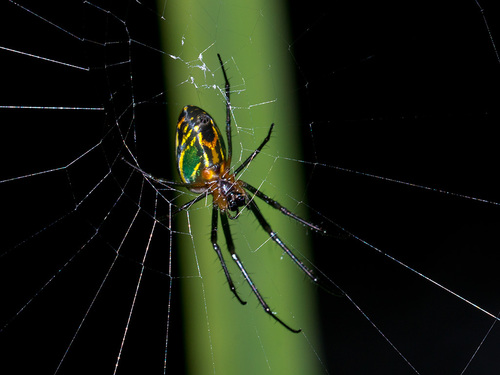
The sides and ventral surface of the abdomen of Leucauge mariana have a complex array of green, yellow, black, white, and red markings. In contrast, the dorsal surface of the abdomen is silvery white with dark streaks, and its legs are mostly green. When this spider rests at the center of its roughly horizontal web, predators and prey that view it from above will see the complex color patterns on its ventral surface, which may help camouflage the spider. Predators and prey that look up at the spider from below will see the silvery white dorsal pattern, which may also provide camouflage against clouds and bright sky. The red markings may also act as a warning to potential predators, because L. mariana produces a weak unpleasant odor that can be detected when holding a spider close to the nose in one's fingers. An early instar spiderling of this species has a relatively large brain that displaces other organs in its cephalothorax, and also fills an outward bulge on the lower wall of the cephalothorax. This bulge gradually disappears as the spider grows to its adult size. While the absolute size of the brain of an early instar L. mariana is much smaller than that of an adult, the larger relative size of the spiderling's brain and the sharp reduction in neuron diameter leave spiderlings and adults with similar numbers of neurons. This similarity may explain why spiderlings show no behavioral deficits in web construction when compared to adult spiders. Leucauge mariana is found across a range from Mexico to Argentina. In the Valle Central of Costa Rica, these spiders are very common among weeds in early secondary growth areas and along wooded streams. Before human arrival, secondary vegetation of this type grew near rivers, landslides, and tree-fall gaps. In Costa Rica, population densities are much higher in the late rainy season and the start of the early dry season, though mature individuals can be found year-round. Males are often found on the webs of mature females or the webs of penultimate females. Males and females caught in the wild can live for a week or longer in captivity without extra food if kept in a humid environment. Mature females living in the wild have been observed to live for several weeks. It is thought that females lay multiple clutches of eggs, but this has not been confirmed in natural conditions. In Mexico, females lay eggs in sheltered spots, such as under leaves within leaf litter.