About Leucas aspera (Willd.) Link
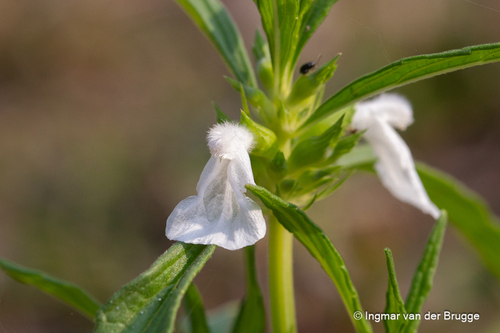
Leucas aspera (Willd.) Link is an annual herb or undershrub that grows 15–60 cm (6–24 inches) tall. Its leaves are arranged oppositely, and are either nearly stalkless or have short petioles. Leaf shapes range from linear to narrowly oblong-lanceolate; leaf margins are either entire or distantly crenate, leaf tips are obtuse, and leaves narrow toward their base. Mature leaves can grow up to 8 cm (3.1 inches) long and 1.25 cm (0.49 inches) wide, while petioles are typically 2.5–6 mm (0.098–0.236 inches) long. The leaf epidermis is covered by a thick waxy cuticle and pierced by stomata. The stem of Leucas aspera is quadrangular, heavily branched, and covered in stiff rough hairs, and contains a wide stele. The stem epidermis also has a thick waxy cuticle, with only a few stomata. In young stems, xylem tissue is arranged radially, and the parenchymatous phloem tissue is very narrow. As the stem ages, phloem tissue widens, and can be found on both sides of the radial xylem tissue. The roots of Leucas aspera have very narrow, closely packed epidermal cells. The cell walls of these epidermal cells are thin, flattened, and straight. Cortical parenchyma has thick cell walls; parenchyma cells are polygonally shaped and contain large amounts of starch grains. A cambium layer separates phloem and xylem, which are globose to subglobose in shape. Leucas aspera is commonly found across India and the Philippines, as well as the plains of Mauritius, Reunion Island, and Java. It is a very common weed in both India and the Philippines. This species typically grows in dry, open, sandy soil, and is abundant in waste areas. It is used as a culinary herb to add fragrance to food. Leucas aspera has been reported to have antifungal, prostaglandin inhibitory, antioxidant, antimicrobial, antinociceptive, and cytotoxic activities. In Philippine traditional medicine, it is used to treat snake bites. It also acts as an antipyretic, helping to reduce fevers. In some traditional medicine practices, steam from crushed whole plant material (including flowers, seeds, roots, berries, bark, and leaves) is inhaled. Flower juice of the plant is also used to treat intestinal worm infections in children. Leucas aspera is commonly used as an insecticide, and has also been used in witchcraft.