About Leucanthemum ircutianum (Turcz.) DC.
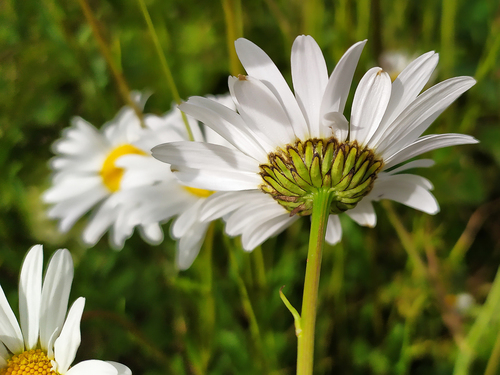
This is an upright herbaceous perennial daisy with the scientific name Leucanthemum ircutianum (Turcz.) DC. It grows 20 to 80 centimetres tall. Its stem is usually firm, covered in short trichomes, and only rarely branches out. The alternately arranged simple leaves are sessile (they have no leafstalk), with serrated or shallowly lobed margins, and a shape ranging from lanceolate to spatulate. This species has no stipules. Like other species in the family Asteraceae, L. ircutianum has flowers grouped into a pseudanthium, also called a calathidium. The outer layer of this structure holds multiple whitish, strap-shaped ray flowers, while the inner area contains numerous yellowish, circular tiny disc flowers. Bracts are present, and the inflorescence is surrounded by lanceolate involucral leaves. The calyx is modified into a pappus, and this species has an inferior ovary. Seeds are enclosed in a brown dry fruit called an achene, more specifically a cypsela. L. ircutianum is an entomophilous species. Its large, noticeable inflorescences mimic a single flower to attract a variety of insect pollinators. This daisy flowers between May and October. L. ircutianum, commonly called oxeye daisy, is distributed across Eurasia (mostly Europe, with some parts of Asia) and North America. In Europe, its distribution area includes Germany, France, former Soviet Union, Spain, Italy, Albania, Austria, the Baltic States, Belgium, Bulgaria, Finland, Great Britain, Portugal, Romania, Sardinia, Sicily, Sweden, Switzerland, and former Yugoslavian countries. In North America, L. ircutianum occurs in both the USA and eastern Canada. This daisy usually grows in a wide range of habitats, including some anthropologically modified urban areas. It is commonly found in meadows, on forest edges, near paths and roads, and in other types of ruderal landscapes. In the Raunkiær plant life-form system, it is classified as a hemicryptophyte.