About Leucania stenographa Lower, 1900
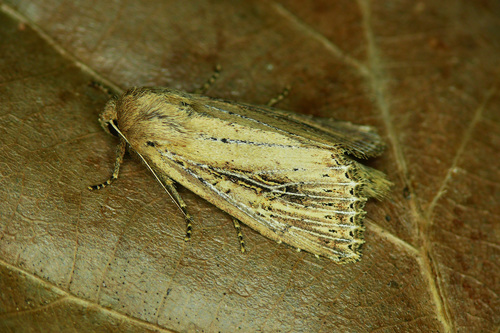
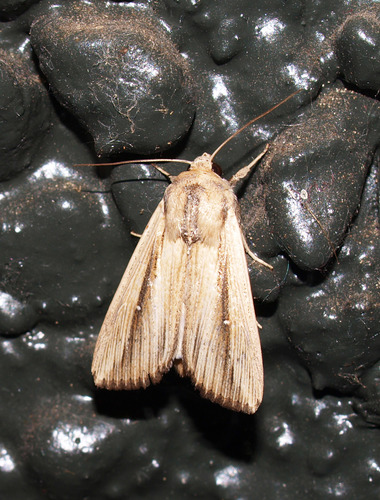
Leucania stenographa was originally described by Lower in 1900 as follows: Adult males and females measure 38–40 mm. The head, palpi, thorax, legs, and abdomen are ochreous-fuscous. The face has two narrow, interrupted fuscous bars, and the thorax bears two anterior transverse bands, with the anterior band very fine and the posterior band very broad. The coxae are densely hairy, and the posterior pair are mixed with fuscous. Antennae are fuscous-ochreous. The underside of the abdomen is more ochreous in tone. Forewings are elongate, moderately dilated, with an almost straight costa and a gently rounded hindmargin. They are ochreous, strongly infuscated all over with fine fuscous and dark fuscous lines. These lines are edged by an equal width of the ground colour on the hindmarginal area, creating the appearance of alternating ochreous and fuscous lines. The lower edge of the cell becomes very strongly infuscated, and this darkening sometimes continues more or less as a thick streak to the apex. There is a fine whitish-ochreous spot at the end of the cell, and an outwardly curved row of fine black dots running from 5/6 of the costa to the inner margin before the anal angle. The cilia are ochreous-fuscous, with a hindmarginal row of black intervenal spots that are more distinct on the underside. Hindwings have a very slightly waved hindmargin, and are iridescent-whitish, with a fine fuscous hindmarginal line, and whitish cilia. This species occurs across most of Australia, including South Australia, Western Australia, New South Wales, Queensland, Tasmania, and Norfolk Island. It is also found in New Zealand and the Cook Islands.