About Leucadendron microcephalum (Gand.) Gand. & Schinz
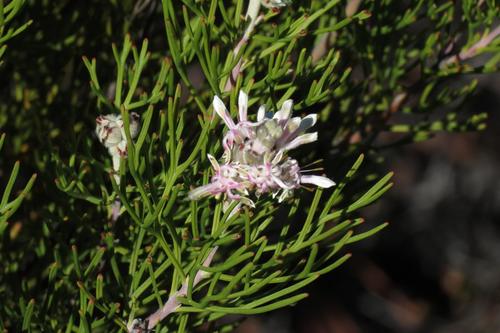
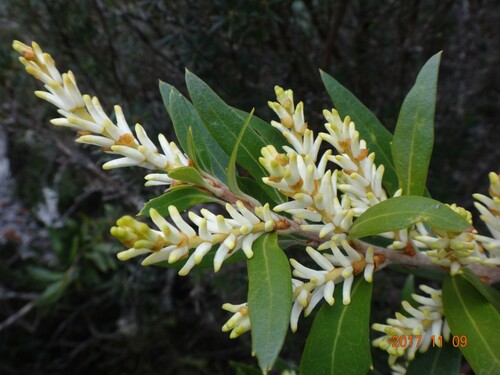
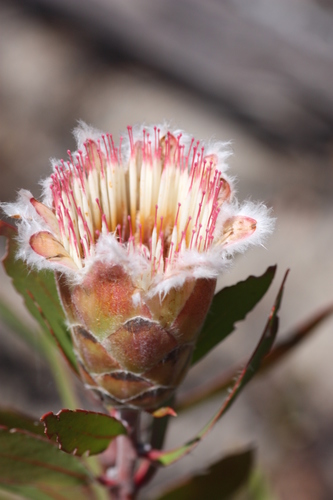
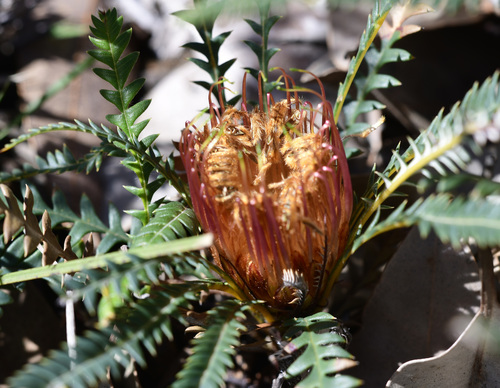
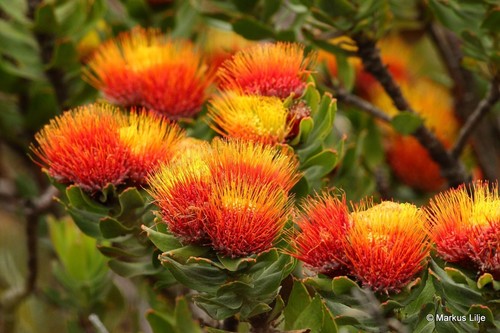
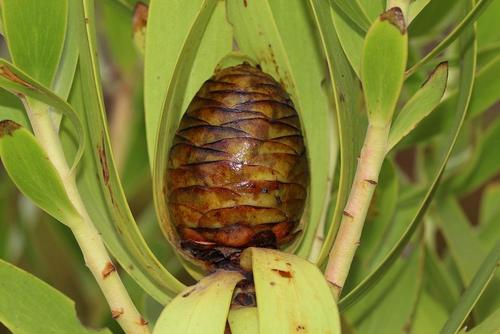
This species is commonly called the oilbract conebush, named for the brown, sticky, oily bracts present on both male and female plants when in bud – a feature that distinguishes it from other Leucadendron species. After flowering, the bracts close and harden into a dry, durable cone, which protects the enclosed flowerhead and heart-shaped fruits. Leucadendron microcephalum produces hairless leaves that are roughly 90 mm (3.5 in) long. It bears yellow, beetle-pollinated flowers in July and August, with male and female flowers growing on separate plants; male flower heads are around 18 mm in diameter, while female flower heads are around 11 mm in diameter. Male shrubs have a rounded growth form and reach up to 1.5 m (4.9 ft) tall, while female shrubs have a narrow crown and grow up to 2 m (6.6 ft) tall. Its involucral leaves are yellow. Intense seasonal fires kill mature plants, but seeds retained in the flower heads or woody capitula can survive for several years to establish the next generation. This is a highly gregarious species that grows in dense stands of hundreds of thousands of individuals. It typically grows on mountainsides in stony sandstone soils, and is especially numerous in the area around Villiersdorp. Its distribution range includes Kogelberg, Kleinmond, Klein River, the Groenland Mountains north of Grabouw, Hottentots-Holland, Du Toit's Kloof Mountains, Riviersonderend Mountains, and the Swartberg above Caledon.