About Leucadendron coniferum (Thunb.) Meisn.
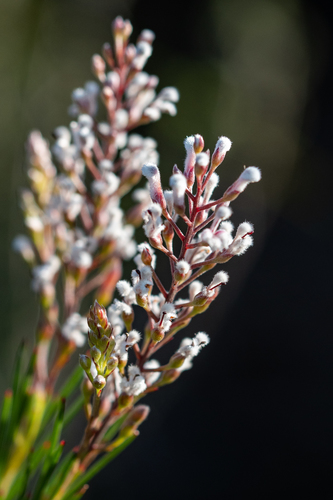
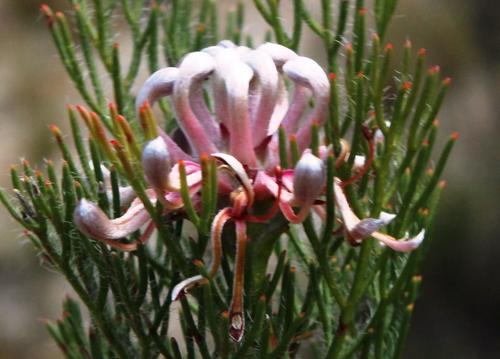
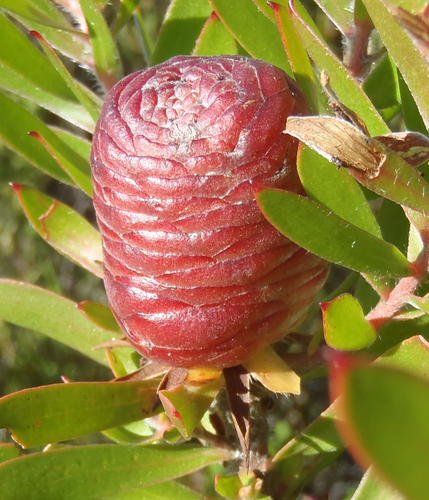
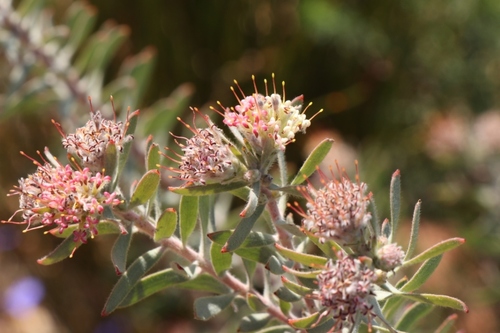
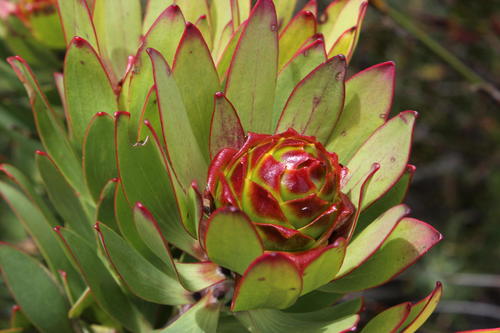
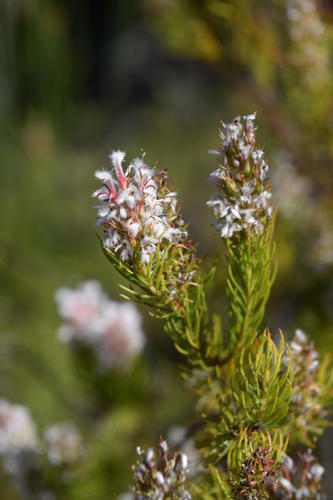
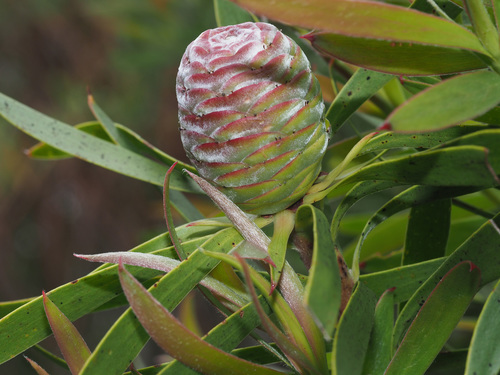
Leucadendron coniferum, commonly called dune conebush, is an evergreen, dioecious shrub or small tree that grows up to 4 m (13 ft) tall, and develops from a single main stem near the ground. Its branches are slightly lengthwise grooved; they initially have rusty hairs pressed to their surface, and later only retain some powdery hairs. Its leaves have a cartilaginous texture, are either hairless or covered in soft hairs, and are linear inverted lance-shaped, 3.2–6.4 cm (1.25–2.5 in) long and 3–5 mm (0.12–0.20 in) wide. Each leaf tip ends in a relatively long, sharp extension of the midvein, and the leaf surface is either hairless or slightly softly hairy. Male flower heads are surrounded by an involucre of a few yellow leaves, which become progressively shorter and broader at the base closer to the head. Male flower heads are cone-shaped, egg-shaped, or nearly globe-shaped, and measure around 1.25 cm (0.5 in) in diameter. The bract that subtends each individual male flower is around 1.5 mm (0.06 in) long, oblong, with a nearly pointed tip. It is covered in long, soft, winding hairs, and has a regular row of straight hairs along the upper half of its margin. In male flowers, the lower part of the 4-merous perianth, which stays merged when the flower opens (called the tube), is around 2 mm (0.08 in) long, slightly compressed, and covered in long, soft, straight hairs. The middle part of the perianth, made up of four free segments after the flower opens (called claws), is around 2.5 mm (0.10 in) long, linear spade-shaped, and covered in long, soft, straight hairs. The upper part of the perianth consists of four segments (called limbs), around 1 mm (0.04 in) long, oblong with a blunt tip, and covered in long, soft, straight hairs. The oblong anthers are directly fused to the perianth limbs, and measure around 0.7 mm (0.025 in) long. The rudimentary style in the male flower is around 3 mm (0.12 in) long, cylinder-shaped, somewhat flattened below, narrows toward the top, and is covered in soft hairs. It is capped by a blunt hoof-shaped stigma that is 0.7 mm long. At the base of the style are four line-shaped scales around 1 mm long. Female flower heads measure around 14 mm (0.56 in) in diameter. The dune conebush is distributed from the Cape Peninsula in the west, through the coastal areas of the Kogelberg, Kleinmond, and Groenland, to the Klein River Mountains in the east near Hermanus. It grows in dense stands on wind-blown sands, at altitudes between sea level and approximately 300 m (900 ft). It is pollinated by small beetles. Seeds remain stored for many years in woody cones on female plants, and are only released after a fire. The winged seeds are dispersed by wind. Adult plants do not survive the wildfires that occur roughly every decade in the sand fynbos and strandveld habitats where this species grows. Germination begins quickly after seeds are released, and smoke has been shown to promote seed germination. This species naturally grows in acid, nutrient-poor environments, and is relatively sensitive to elevated phosphate levels. The cones of this species, with their papery bracts that resemble spruce cones and are known as "sabulosum cones", are sometimes collected for use in potpourri.