About Lethe rohria Fabricius, 1787
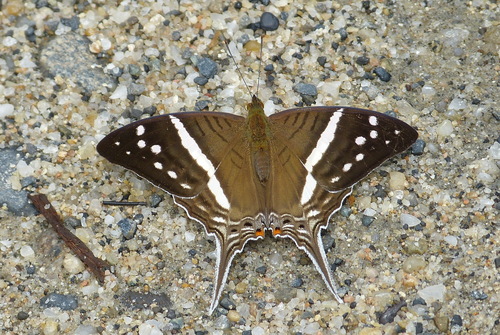
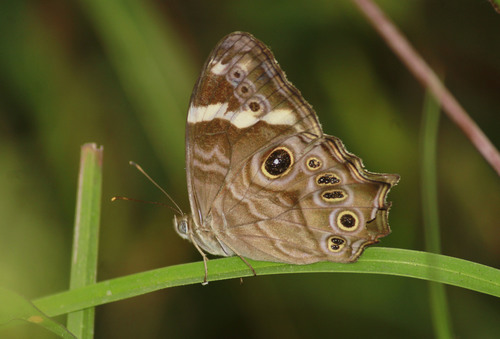
Lethe rohria, formally described by Fabricius in 1787, has shared and sex-specific wing traits for both males and females. On the upperside of the wings, both sexes are van Dyke brown, with color darkening slightly towards the apex of the forewing, particularly in females. For males, the forewing has one costal and two preapical white spots. On the male hindwing, the underside's eyespots (ocelli) show through the wing, sometimes forming two or three faint black spots, plus two thin subterminal black lines. The underside of male wings is paler than the upperside and shaded with dark brown. On the male forewing underside, there are narrow subbasal and outer cellular transverse sinuous white lines; an irregular broad discal white band and a narrower postdiscal white band that together form a V shape. The postdiscal band holds a series of four blind, dusky-black ocelli ringed with fulvous. The two preapical white spots match those on the upperside. There are also a distinct thin subterminal whitish line and a broader terminal ochraceous line on the male forewing underside. On the male hindwing underside, there is a subbasal transverse sinuous white line, followed by an arched postdiscal series of six black ocelli with broken, disintegrated centers. Each ocellus has an inner ochraceous ring and an outer brown ring, and the entire series is bordered both inwardly and outwardly by lilacine (lilac-colored) white lines. Finally, the male hindwing has a thin white subterminal line and a broader ochraceous terminal line, identical to those on the forewing. The female's upperside differs from the male's: it has a broad, oblique, white discal band on the forewing, plus a spot below the posterior end of this band in interspace 1. The inner edge of this band is bi-emarginate, while the outer edge is irregularly sinuous. The female underside matches the male's, but all markings are more pronounced, and the white discal band on the forewing is very prominent. Antennae, head, thorax and abdomen are all brown. The antennae are black preapically, and ochraceous at the apex. This species is distributed across the Himalayas, occurring in the Indian states of Uttarakhand, Sikkim and Assam, Bhutan, and Myanmar (Tenasserim), with its range extending to China.