About Lethe drypetis (Hewitson, 1863)
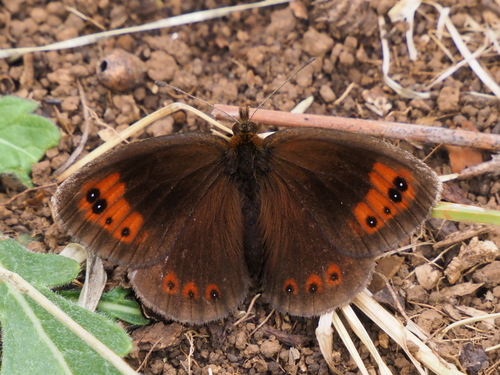
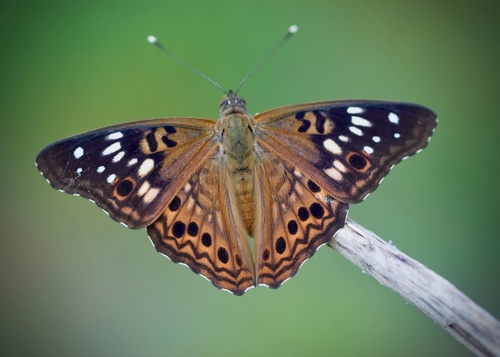
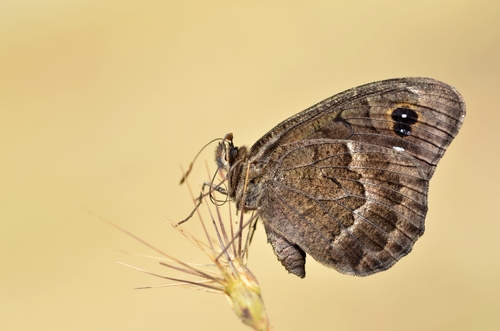
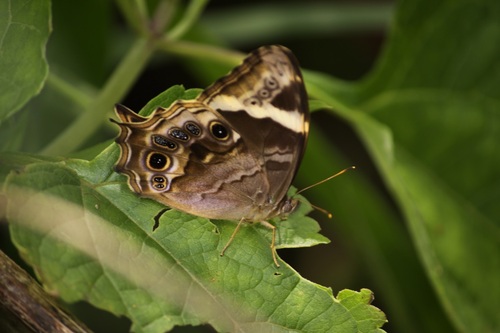
Lethe drypetis (Hewitson, 1863) has distinct appearance traits for males and females. For males: The upper side of the wings is a very dark Vandyke brown. The forewing is uniformly colored, while the hindwing has a postdiscal series of three or four blind black ocellar spots. The underside of the wings is brown. On the forewing underside, the area below vein 2 and the terminal margin are paler. A broad band crosses the cell, and the medial region and apex of the wing are suffused with lilac; this forewing bears an incurved postdiscal series of five blind black ocelli. On the hindwing underside, there are narrow transverse lilac bands in the sub-basal and discal positions: the sub-basal band is sinuous, and the discal band is angulated on vein 4. An arched postdiscal series of black ocelli ringed with fulvous can be found here, and some of these ocelli have disintegrated centres. The medial area of the hindwing is suffused with lilac, and the ocelli have lilacine lunules on both sides. Both forewings and hindwings have slender lilacine subterminal lines and broader ochraceous terminal lines. Females are similar to males but have a paler ground color. On the upper side of the female forewing, there is a broad oblique white discal bar and two white preapical spots. On the upper side of the female hindwing, there is a large, rectangular black subterminal mark in the interspaces, along with a white spot above and below this mark. The underside of the female's wings is similar to that of the male, but all markings are more prominent, and the lilac, ochraceous, and brown shades are paler. The broad forewing discal bar that appears on the upper side is present on the underside as well, and is joined by a nearly vertical lilacine white band that holds the series of ocelli. On the female hindwing, a brown transverse discal band is very broadly produced between veins 4 and 5. The antennae, head, thorax, and abdomen are brown; the apex of the antennae is ochraceous. The wingspan of Lethe drypetis ranges from 64 to 68 mm. This species is found in southern India and Sri Lanka.