About Lethe confusa Aurivillius, 1897
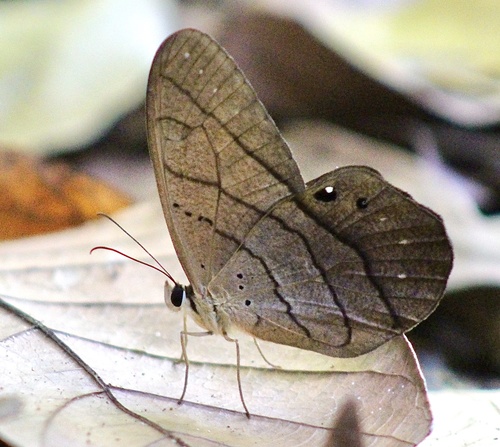
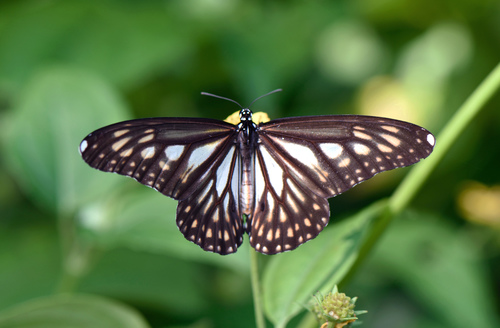
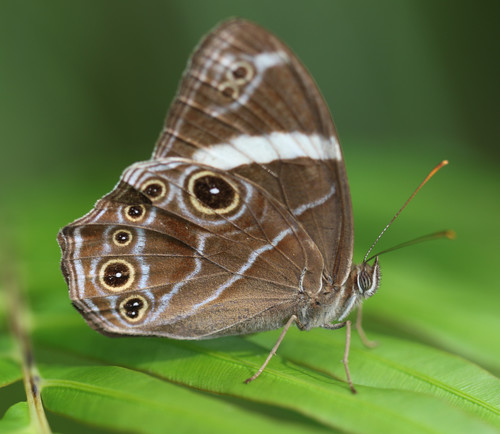
Lethe confusa Aurivillius, 1897 can be described by the following morphological characteristics. The apex of vein 4 on the hindwing has a dentate, or toothed, edge. The ground color of the upperside of the wings is Vandyke brown. An oblique, slightly curved discal white band crosses the forewing; the margins of this band are more even and regular than the equivalent band found on female Lethe rohria. Beyond this white band, there are two obliquely positioned preapical white spots. The hindwing upperside is uniformly colored, and the ocelli from the wing's underside show through this surface. The underside of the wings is uniformly brown; both forewings and hindwings have sinuous, or wavy, lilacine-white subbasal, subterminal, and terminal lines. The forewing has the same oblique discal white bar that appears on the upperside, which is followed by a subapical lilacine patch that holds three small ocelli arranged in a vertical order. A very short, oblique white bar connects this lilacine patch to the forewing costa. The hindwing has a sinuous, irregular, angulated discal lilacine-white line, plus a strongly arched series of black ocelli. Each ocellus is speckled with white at its center, and surrounded by three rings: an inner ochraceous ring, an intermediate brown ring, and an outer lilacine ring. The antennae, head, thorax, and abdomen are all dull brown; the apex of each antenna is ochraceous. The species' wingspan measures 54 to 64 millimeters. Its geographic range spans from the Himalayas between Shimla and Sikkim, through Assam into Myanmar, and extends as far as Java.