About Letharia lupina Altermann, S.D.Leav. & Goward
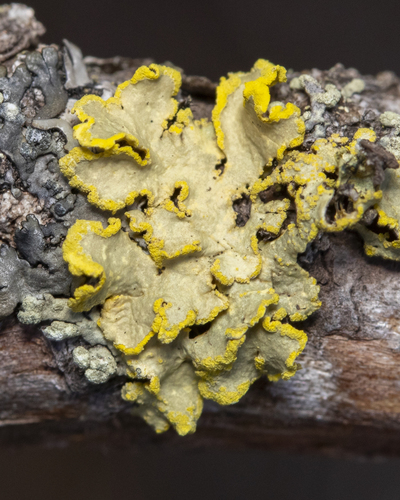
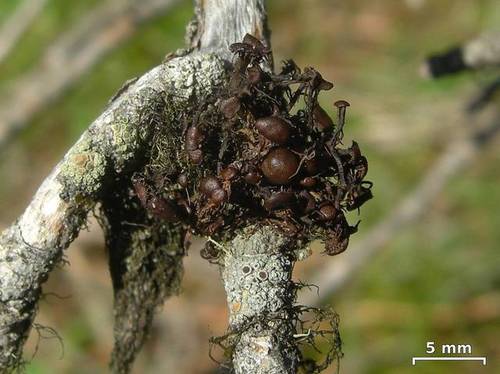
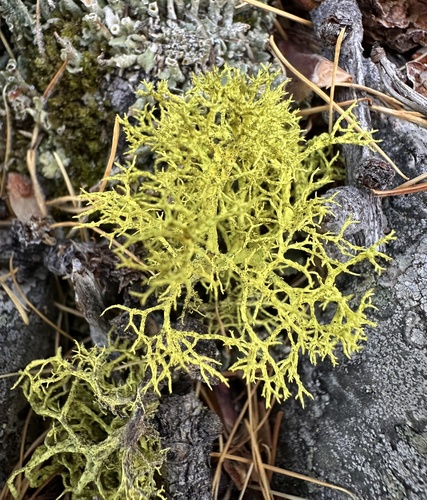
Letharia lupina Altermann, S.D.Leav. & Goward produces a fruticose, shrubby and bushy thallus that is often vivid lemon yellow to chartreuse green. It typically has darker brown to blackened branch tips and a paler, often whitish base. Mature thalli usually measure 5–20 cm (2–8 in) in length and 4–8 cm (1+9⁄16–3+1⁄8 in) in width, with coarse branches that are 1–3 mm wide near the base. In cross-section, branches are round or more commonly angular-ridged. While overall irregularly branched, branches tend to fork roughly equally (dichotomously) near the tips. The ridges hold pseudocyphellae, which are small pores or breaks in the outer cortex. These pseudocyphellae usually bear small vegetative propagules called isidia, which can be sparse or dense. Isidia are typically globular to weakly cylindrical, around 0.1–0.3 mm long, and may later be replaced by weakly corticate outgrowths called gymnidia. Fruiting bodies called apothecia are rare, usually appearing late in development on large thalli. They are typically 0.75–1.50 mm across, occasionally larger, with a pale to dark brown disc that is strongly concave when young. The thalline margin is raised and inrolled when young, and may have few or no short fibrils. The underside of the margin is strongly pitted and sorediate. Ascospores are simple, hyaline, ellipsoid, and measure 5–7 × 3–4 μm. Pycnidia are also rare, and their conidia are straight and measure 7–9 × 1 μm. The cortex contains vulpinic acid and atranorin, and the hymenium of the apothecia contains norstictic acid. In western North America, Letharia lupina is widely distributed. According to the original authors' assessment, it is encountered more often than L. vulpina s. str., and was identified as the predominant Letharia lineage among the North American samples included in their study of sequenced material. It is the more widespread of the two North American lineages, extending east of the Continental Divide into Alberta and Saskatchewan, and south through parts of the interior western United States, including Montana, Wyoming, south-western South Dakota, Utah, and Nevada. In mountainous regions, it spans a broad elevational range from valley bottoms to treeline, roughly 190–3,370 m (620–11,060 ft). It has also been reported from Veracruz in eastern Mexico. In North America, the lineage later described as L. lupina is most common in the interior western mountains, while L. vulpina more often occurs in warmer coastal mountains near the Pacific, though the two can grow together locally. This species commonly grows on old fence posts and the bare decorticated trunks and branches of conifers, especially Pinus. It also occurs on conifer bark from species including Abies, Calocedrus, Picea, and Pseudotsuga. On hardwoods, it most often colonizes exposed wood, and has been reported from Arbutus, Arctostaphylos, Populus and Salix. It has also been observed on the corticated bark-covered branches of Betula and Quercus. Saxicolous rock-dwelling thalli have occasionally been found on granitic outcrops. Outside North America, it has been reported from the Atlas Mountains of Morocco growing on Cedrus atlantica, and from Switzerland; the Swiss photobiont belongs to the same algal clade as North American material. Genomic studies of wolf lichens indicate that Letharia species are typically haploid and heterothallic self-incompatible, with each thallus carrying only one of two mating type idiomorphs. In a broad survey of samples, researchers used PCR polymerase chain reaction to test for mating-type genes and found that North American populations of L. lupina include both mating types in roughly equal proportions. This matches the pattern of regular sexual reproduction, even though apothecia are seldom produced. Long-read metagenomic sequencing has produced a high-quality reference genome for L. lupina, which is about 49 Mb assembled into 31 contigs. In that same sample, analysis of sequencing depth and genetic variation showed that the thallus contained at least two distinct fungal haplotypes, suggesting that individual thalli may sometimes include more than one genotype. However, metagenomic sequencing of one L. lupina thallus showed a triploid-like genetic signal. The study authors interpreted this as evidence of hybridization between L. lupina and another Letharia lineage, and discussed several mechanisms that could produce such individuals. A targeted DNA screen for lichen-associated basidiomycete yeasts detected cystobasidiomycete yeasts in all three tested L. lupina thalli; the two Tremella targets screened for were not detected in these samples. Culturing of surface-sterilised thallus sections has also yielded other lichen-associated fungi. In one study, a filamentous fungus identified as Anthostomella pinea was isolated from L. lupina material and later characterised with whole-genome sequencing. Genome mining of L. lupina suggests it has extensive potential for secondary metabolism: one analysis of its published genome predicted 42 biosynthetic gene clusters, including 21 predicted polyketide clusters. The same study discussed prenyltransferase genes in lichen-forming fungi that are often annotated as dimethylallyltryptophan synthases, but argued from comparative analyses that most are more likely involved in modifying tyrosine- and polyketide-derived compounds rather than indole alkaloids, which have not been reported from lichens.