About Lestes dryas Kirby, 1890
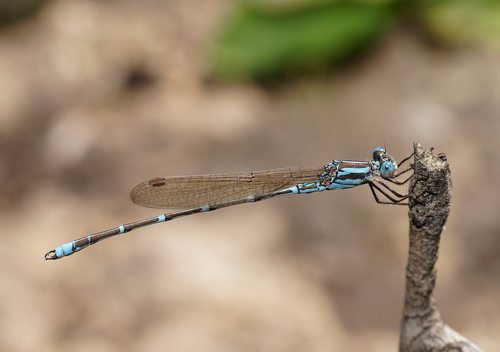
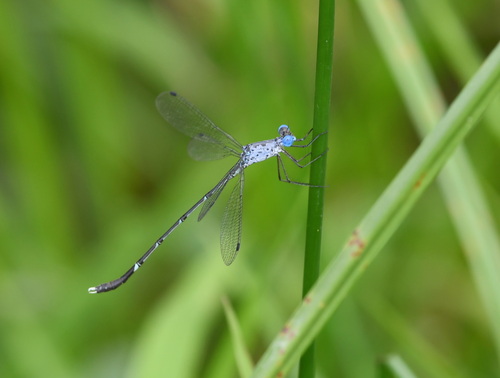
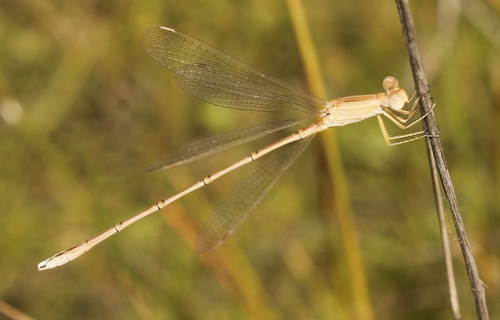
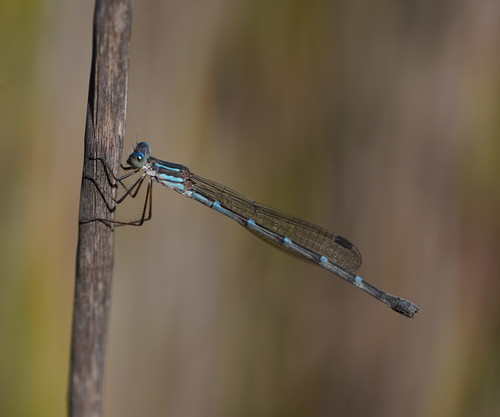
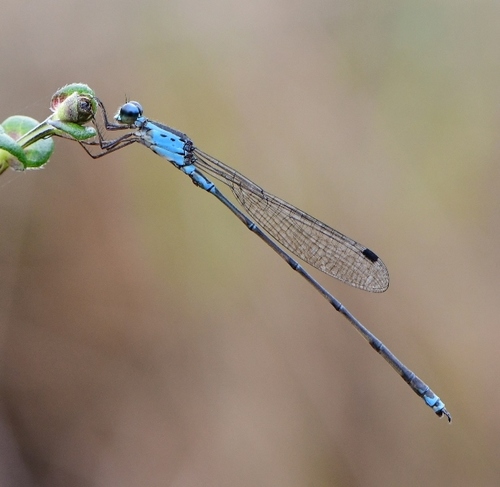
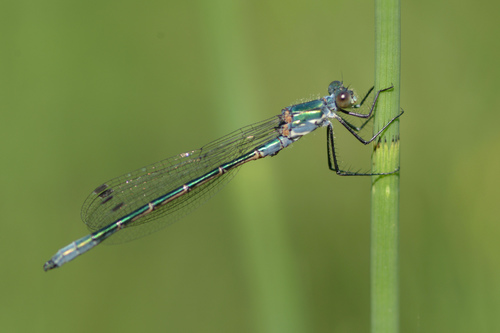
Identification: This damselfly has a total length of approximately 35 to 42 millimetres (1.4 to 1.7 inches), with males typically longer than females. Males have a wingspan of around 45 millimetres (1.8 inches), while females have a wingspan of around 47 millimetres (1.9 inches). Like all other members of the genus Lestes, both sexes of Lestes dryas have mostly metallic green bodies with a bronze iridescence, and they usually rest with their wings held half spread. L. dryas looks extremely similar to the closely related emerald damselfly Lestes sponsa, so careful examination is required to distinguish the two species. Male L. dryas have blue eyes; as individuals age, they develop a powdery blue pruinescence across their bodies. While all Lestes damselflies share very similar general appearances, the identifying characteristic for the genus is the shape and colour of the anal appendage. The anal appendages of both L. dryas and L. sponsa are black, whereas the anal appendages of all other European Lestes species are white or light coloured. L. dryas and L. sponsa can be told apart by their slightly differently shaped anal appendages, as visible in reference photographs. Female L. dryas have a more robust abdomen than males. Females have no blue colouration on their bodies, have brown to green eyes, and have beige-coloured underparts. Habitat and distribution: L. dryas occurs across a global latitudinal band stretching from 40° north to 60° north, covering central Europe and Asia from France all the way to the Pacific Ocean, as well as all of North America. It is the only Lestes species that is found in both Europe and North America. In regions around the Mediterranean, this damselfly is only found at higher altitudes. It inhabits still, shallow water in well-vegetated environments including ditches, ponds, bogs and lakes, and can also be found near the coast in slightly brackish water. It is widespread across Europe, but never reaches the same level of commonness as L. sponsa. It was previously thought to be extinct in Britain before it was rediscovered there in 1983; since rediscovery, it has been recorded at multiple sites across south-east England, with breeding populations concentrated mainly around the Thames Estuary, plus a small number of inland lakes in Norfolk and Ireland.