About Lestes dorothea Fraser, 1924
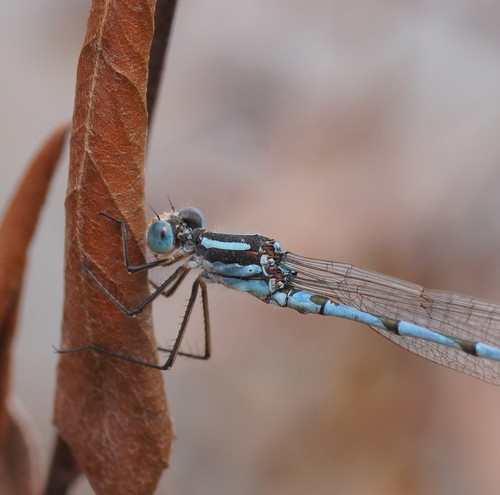
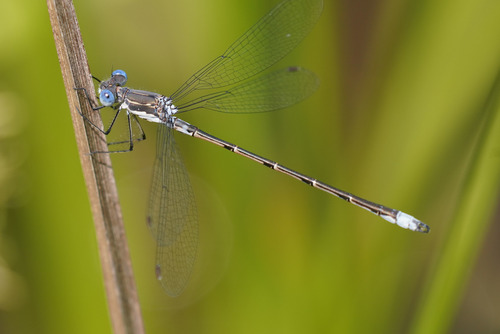
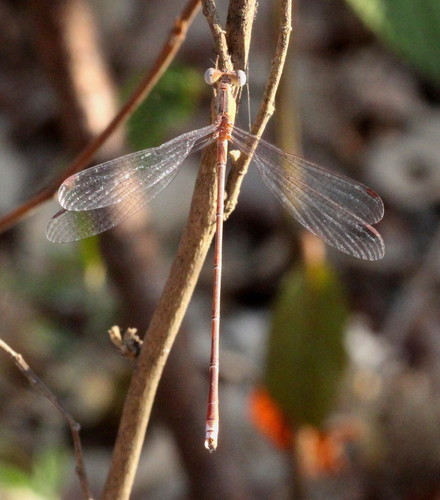
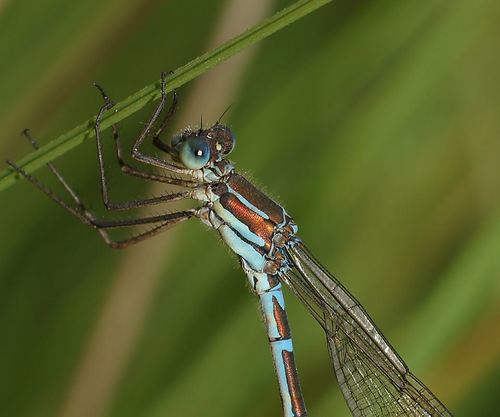
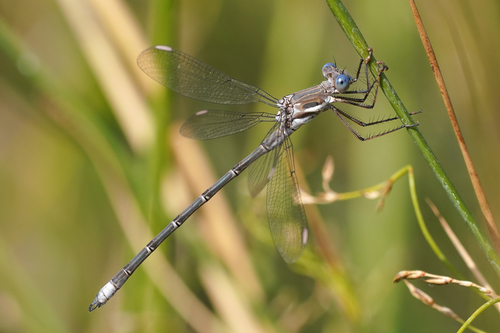
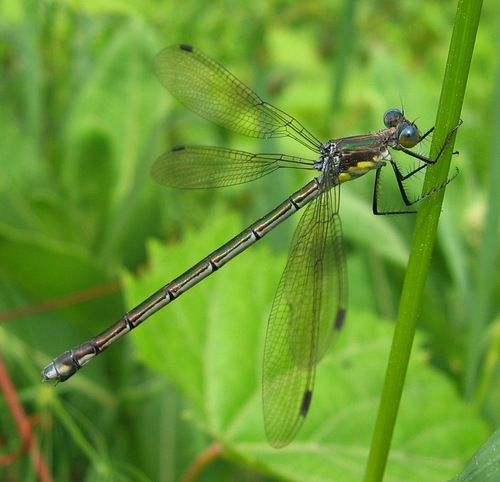
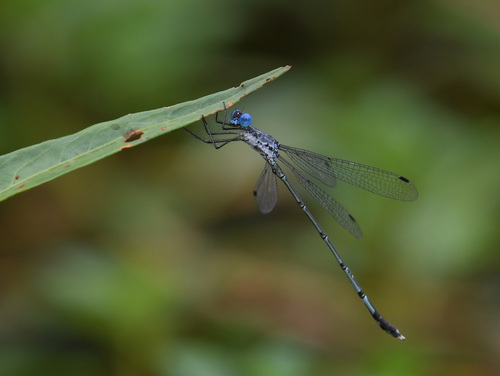
Lestes dorothea is a large species of damselfly. Males have an abdomen length of 36 to 40 mm, compared to the morphologically similar Lestes praemorsus, which has an abdomen length of 32–35 mm. The head of Lestes dorothea is black, and mature males have deep sapphire-blue eyes, a feature shared with L. praemorsus. Its thorax is black, with white pruinosity on the sides and citron-yellow color on the underside. The dorsum of the thorax has a pair of metallic green antehumeral stripes shaped the same as those found in L. praemorsus. After the stripe on each side, L. dorothea has a diffuse black stripe along the humeral suture, a large diffuse black spot just in front of the upper part of the postero-lateral suture, a smaller spot at the middle of the antero-lateral suture, and a third spot over the spiracle. L. praemorsus does not have this black stripe, and only has several irregular spots on both sides of its thorax. The thorax of mature male L. dorothea is heavily pruinosed, which obscures all these markings. The wings are hyaline, and the pterostigma is black. The abdomen is blue or greenish-blue, marked with black. Segment 8 has a fine basal blue ring, segment 9 is entirely black, and segment 10 is black with white pruinosity on the dorsum. In L. praemorsus, segment 9 has very large blue lateral spots. The anal appendages are bluish when the individual is alive, and broadly black at the base and apex. In females, the thorax is olivaceous green, with pale greenish yellow on the sides. The markings are broader and more visible than they are in males. The female anal appendages are small and black. This species can be distinguished from L. praemorsus by its much larger size, the absence of blue markings on male segments 8 and 9, the diffuse black stripe on the humeral suture, and its higher postnodal index. It breeds in well-vegetated ponds and similar habitats.