About Lessonia oreas (P.L.Sclater & Salvin, 1869)
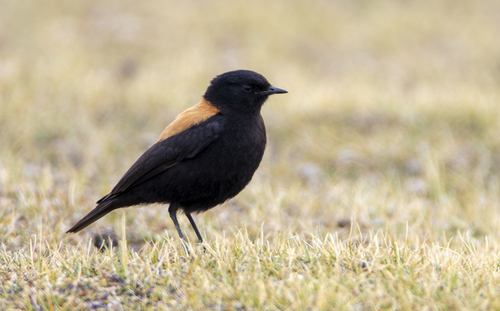
The Andean negrito (Lessonia oreas) measures 12.5 to 13 cm (4.9 to 5.1 in) in total length. Adult males are mostly black with a pale rufous back. The inner webs of their flight feathers are silvery white, which makes the wing appear pale in flight but this marking is seldom visible when the bird is at rest. Adult females are smaller than males; they have mostly blackish brown heads and upperparts, with a dull rufous back. The inner webs of adult females' flight feathers are sandy brown. Females have a whitish chin, sooty breast and belly with rufous edges along the sides of the breast, and a blackish crissum. Juveniles have similar plumage to adult females but are much paler across their entire body. Both sexes have a dark iris, a short black bill, and entirely black legs and feet. They have exceptionally long hindclaws that resemble those of pipits. This species occurs along the Andes mountain range, starting from southeastern Ancash and southwestern Huánuco departments in central Peru and extending south through western Bolivia, eastern Chile as far as the Coquimbo Region, and into northwestern Argentina as far as Catamarca Province. It inhabits open grassy landscapes with scattered low shrubs, located at the margins of lakes, streams, and bogs. Across its full range, it occurs at elevations between 3,000 and 4,000 m (9,800 and 13,100 ft), and can occasionally be found as low as 1,000 m (3,300 ft) in Chile. In Peru, it occurs between 3,100 and 4,600 m (10,200 and 15,100 ft), though there are rare recorded observations of individuals as low as sea level.