About Lessingia arachnoidea Greene
Lessingia arachnoidea is a rare flowering plant in the Asteraceae family, commonly called Crystal Springs lessingia. It is endemic to California, United States. It has been recorded at a small number of sites near Crystal Springs Reservoir on the San Francisco Peninsula, extending south to serpentine soil in Woodside. Unconfirmed populations may also occur in Sonoma County to the north. It grows in chaparral, scrub, grasslands and other local plant communities, all on serpentine soils.
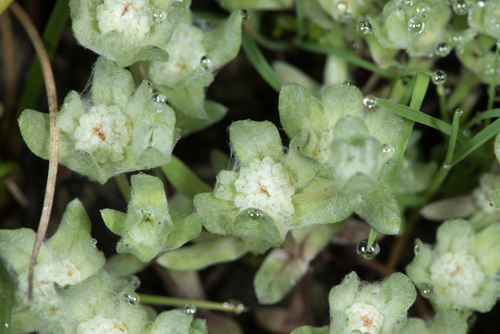
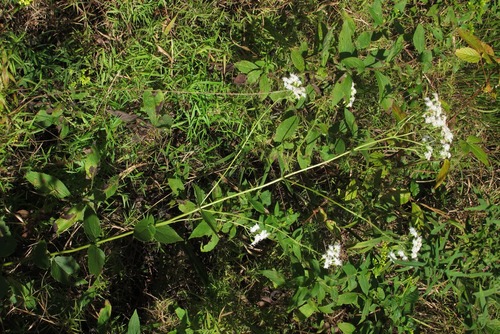
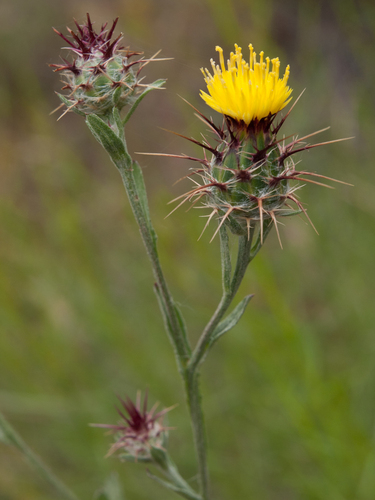
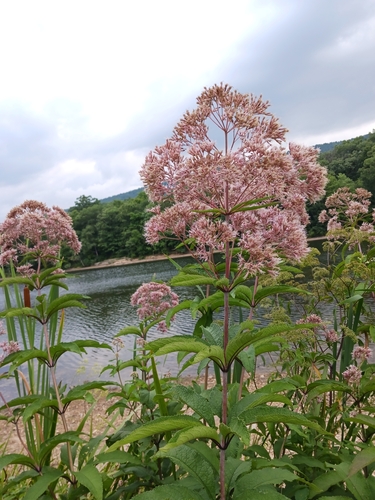
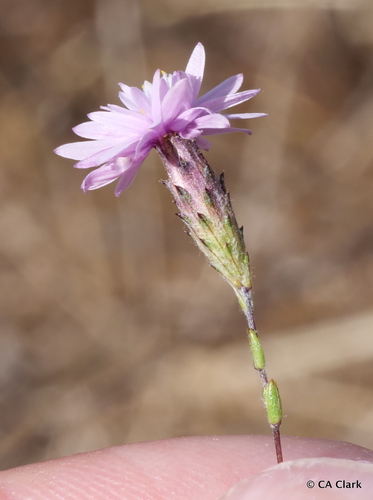
This species is an annual herb that grows a slender, erect stem reaching a maximum height of 80 centimeters. The plant is covered in woolly hairs toward stem tips, with less hair toward its base. Its leaves are narrow and sometimes toothed; the lowest leaves approach 11 centimeters long, while the uppermost leaves are smaller in size. A single flower head forms at the tip of the slender stem. The flower head is lined with tiny, lance-shaped phyllaries that have purplish pointed tips, and sometimes bear a coating of woolly fibers. The flower head is discoid: it has no ray florets, but instead holds several funnel-shaped lavender disc florets with raylike lobes. Its fruit is an achene, with a very hairy hard body 2 to 3 millimeters long, and a small, bristly pappus on top.
This species requires bare soil or soil free of invasive exotic weed competition to thrive, and it can even grow in the bare soil of heavily worn trails. It flowers late, from August to October, making it one of the last summer California wildflowers to bloom. Individuals can grow without rainfall or additional moisture in the soil around their roots, surviving by absorbing nighttime dew through their leaves.
Ripe seeds of this plant germinate readily: 40% germinate within three days, and 80% germinate within 15 days. For conservation management and habitat restoration work, the estimated longevity of this species' seeds in soil is between 100 and 250 years. Although this plant grows in the typically low-nutrient environment of serpentine soil, it still needs a minimum threshold of nitrogen, phosphorus, potassium, calcium, magnesium, copper, zinc, manganese, iron and boron, and a narrow pH range, for seedlings to survive, grow into mature plants, and reproduce. The required pH is 7.1, and the minimum nutrient concentration thresholds in PPM are: 18 PPM for nitrogen, 5 PPM for phosphorus, 31 PPM for potassium, 391 PPM for calcium, 256 PPM for magnesium, 1 PPM for copper, 1 PPM for zinc, 26 PPM for iron, and 0.02 PPM for boron.