About Lespedeza bicolor Turcz.
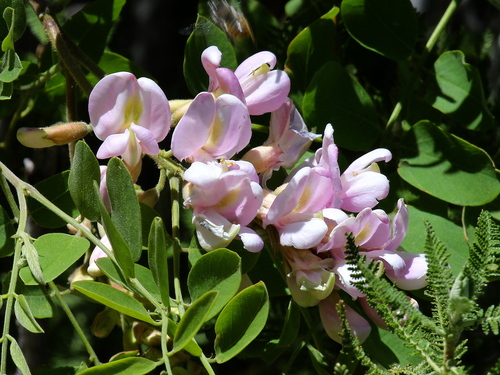
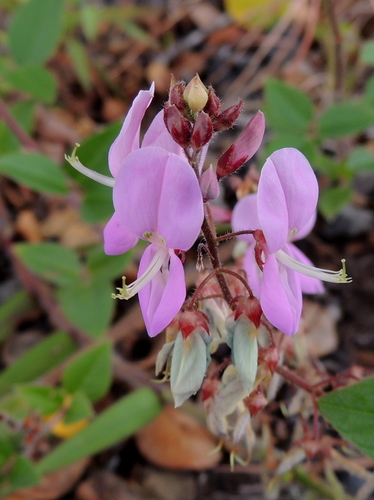
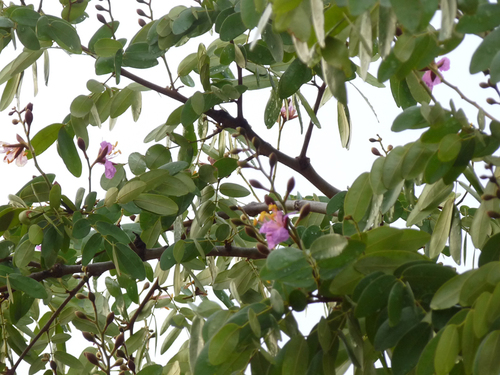
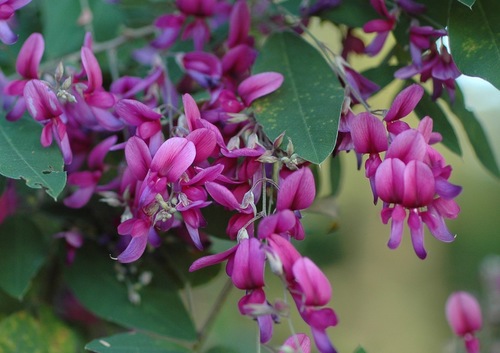
Lespedeza bicolor Turcz. is quite variable in appearance, and a number of cultivars have been developed from it. In general, it is an erect shrub that reaches 3 meters (9.8 feet) in both height and width, and it typically stays smaller when grown in cold climates. It can grow up to 1.5 meters (5 feet) from ground level in a single growing season. The cultivars 'Little Buddy' and 'Yakushima' reach 0.91 meters (3 feet) and 0.46 meters (1.5 feet) tall respectively. This species grows from a thick root system, and its stems can reach 3 centimeters (1.2 inches) in diameter. Its leaves are each composed of three oval leaflets that grow up to 5 centimeters (2.0 inches) long. Its inflorescence is a raceme holding up to 15 open, pealike pink and purple flowers, and it also produces closed, self-pollinating cleistogamous flowers that do not open. The fruit is a flat legume pod nearly one centimeter long that holds a single seed. This plant can grow in many habitat types, including disturbed areas. By the 1990s, it escaped cultivation and became established across many regions of the eastern United States, particularly in the Southeast. In the U.S., it is currently found from New York to northern Florida, and west as far as Nebraska and Texas. It can also be found as far north as Ontario, Canada. In some areas, this plant can form dense stands and becomes an aggressive invader. It is considered a threat in areas where it disrupts or prevents the growth of native plants, including native grasses and trees. It may spread after fire, which can interfere with controlled burn schedules for fire-adapted habitat types. This species was first introduced to the United States as an ornamental shrub in 1856, and it was likely introduced multiple additional times after this initial introduction. In the 1930s, it was recommended for erosion control and for revegetating abandoned mine sites. It was also used to improve wildlife habitat, especially for the northern bobwhite. The United States Department of Agriculture produced and distributed the species' seed, and many millions of plants were planted. A number of strains and cultivars were developed to improve the plant's drought tolerance and seed production.