About Leratiomyces ceres (Cooke & Massee) Spooner & Bridge
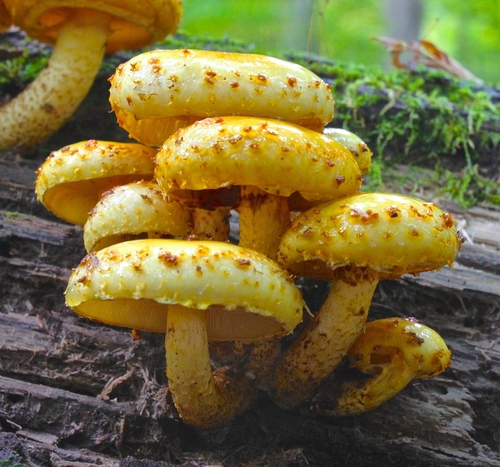
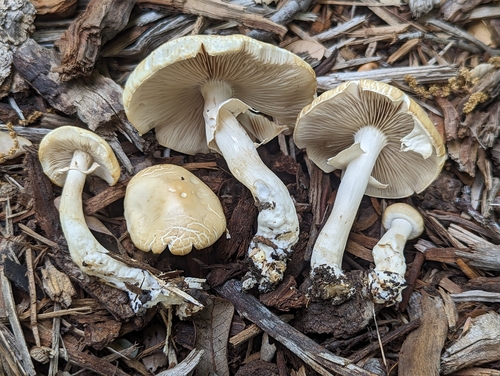
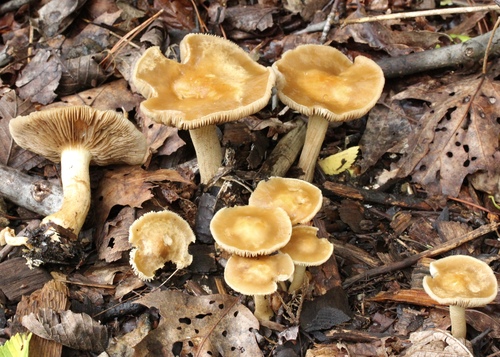
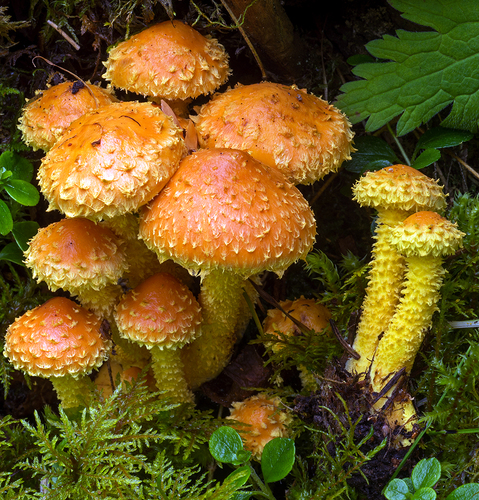
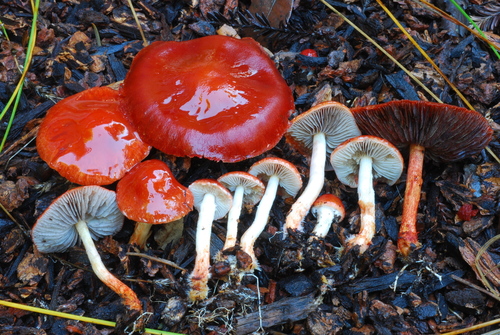
Leratiomyces ceres can be described by the following morphological characteristics. The cap is 2 to 6 cm in diameter, with thin flesh, and has a bright red to orange surface that develops from convex to plane as it ages. Young specimens have white remnants of the partial veil on the cap. The cap surface is usually dry, but can become slightly viscid when growing in moist conditions. The gills are white to pale grey when young, and mature to a darker purple-brown or purplish grey colour, with whitish edges. Gills attach to the stipe in an adnexed to adnate arrangement, and are often notched. The stipe is whitish, and often develops dark orange stains with age, which are most noticeable around the base; it measures 3–6 cm long and 0.5 to 1 cm wide, and is roughly equal in width to slightly wider at the base, which frequently has attached mycelium. The partial veil is thin and leaves a fragile, indistinct ring on the stipe, which may disappear entirely as the mushroom ages. The stipe surface is smooth above the ring zone, and covered in a soft, fluffy layer of tiny scales below the ring zone; these scales are often washed away by rain. Spores are dark purple-brown, measure 10–13.5 × 6–8.5 micrometres, and are elliptical in shape with a smooth surface. Microscopically, chrysocystidia are present on both the edges and the faces of the gills. This fungus typically grows in scattered gregarious clusters on wood chips, and is one of the most common and most easily recognizable mushroom species found in this habitat. It is common growing on wood chips and in lawns across North America, Europe, Australia, New Zealand, and other regions.