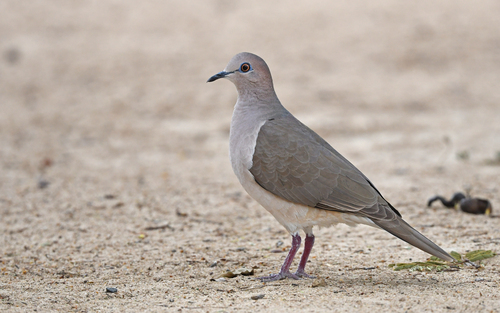
About Leptotila verreauxi Bonaparte, 1855
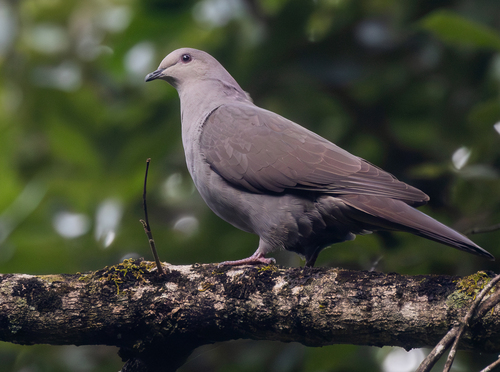
This species, Leptotila verreauxi Bonaparte, 1855, commonly called the white-tipped dove, measures around 28 cm (11 inches) in length and weighs approximately 155 g (5.5 oz). For most regional races, adult birds have a grey tint from the crown to the nape, a pale grey or whitish forehead, and a whitish throat. Across most of the species' range, the eye-ring is typically red, but it is blue in most of the Amazon and northern South America. The upperparts and wings are grey-brown, while the underparts are whitish, fading to pinkish, dull grey, or buff on the chest. The underwing coverts are rufous. The tail has a broad white tip, which is most easily seen when viewed from below or during flight. The dove has a black bill, red legs, and a yellow iris. The white-tipped dove looks similar to its close relative the grey-fronted dove (Leptotila rufaxilla), which prefers humid forest habitats. The clearest differences are the greyer forehead and crown of the white-tipped dove, which contrast less with the hindcrown than the grey-fronted dove's. In regions where the two species overlap, the white-tipped dove usually has a blue eye-ring (compared to the red eye-ring of the grey-fronted dove), but this trait is not a reliable identifier in parts of Brazil, Argentina, Bolivia, Paraguay and Uruguay, where both species typically have a red eye-ring. As a resident breeding species, its range extends from southernmost Texas in the United States, through Mexico and Central America, south to western Peru and central Argentina. It also breeds on the offshore islands of northern South America, including Trinidad and Tobago and the Netherlands Antilles. It lives in scrub, woodland, and forest habitats.