About Leptothorax acervorum (Fabricius, 1793)
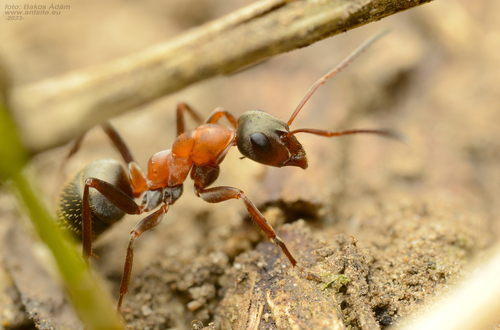
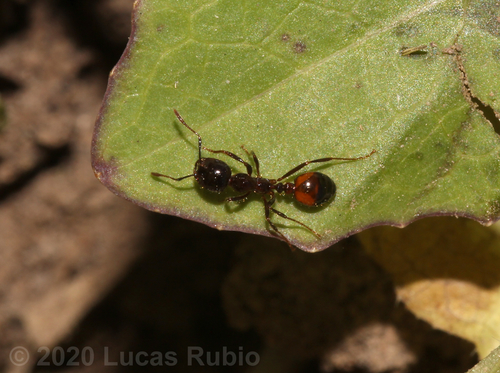
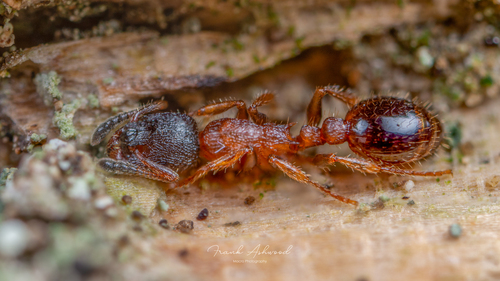
Leptothorax acervorum is a small red ant. Like other ants, it has geniculate (elbowed) antennae, metapleural glands, and a constricted second abdominal segment. Its body is protected by an exoskeleton and split into three main segments: the head, mesosoma, and metasoma. The head holds eyes that detect sharp movement, three small ocelli that sense light and light polarization, two mandibles, and a pair of attached antennae. All six legs attach to the mesosoma. The metasoma contains the ant’s vital internal organs, and its two-segmented pedicel is a characteristic unique to the ant subfamily Myrmicinae. This ant has a two-toned appearance from its dark-colored head and abdomen. Individual workers are very small, measuring around 3 millimetres (0.12 in) in length, while queens are only 10% larger than workers. Colonies of this species are smaller than those of many other ants, containing between a few dozen and a few hundred workers, plus one to several queens. L. acervorum is most commonly found in dry coniferous forests, where it nests in small rotting branches, tree stumps, and under tree bark. Colonies at the periphery of the species’ range have a patchy distribution. This patchiness is positively correlated with increasing latitude: if a queen leaves her original colony due to lack of resources, she has a low chance of encountering and competing with another established colony. The ideal environment for this species is temperate or subtropical biomes, where resources are easily available to support colony survival and success. This species is widely distributed across Central, Western, and Northern Europe, with a range that extends from central Spain and Italy (40° N) north to the tundra/taiga ecotone of northern Scandinavia and Siberia. L. acervorum typically lives in facultatively polygynous colonies, but may form monogynous colonies when located at the edge of its geographic range. At range margins, resources and suitable sites for colony development and nesting are less common. For example, Trettin et al. found that colonies in the northern mountain ranges of Spain are functionally monogynous, and their survival is considered at risk, unlike the low-skew populations preferred in Boreal Eurasia. Heinze et al. identified an additional pattern linked to the species’ geographical range: as colony location moves to higher latitudes toward the edge of the range, the average body size of individual worker ants increases. Workers near the Polar Circle are 10% larger than workers from central Europe. This pattern follows a Bergmann's rule-like pattern for this ectothermic ant. Bergmann's rule states that larger populations and species tend to occur in colder environments, while smaller organisms occur in warmer regions. Consistent with this principle, Heinze et al. suggest that the larger body size of L. acervorum from boreal habitats may result from selection for increased fasting endurance. That is, in colder, resource-poor peripheral habitats, larger body size evolved as an adaptation to survive longer periods of starvation.