About Leptotes plinius (Fabricius, 1793)
This species, both male and female, closely resembles Tarucus theophrastus on the upper side of the wings, but the characteristics and arrangement of markings on the underside are completely different.
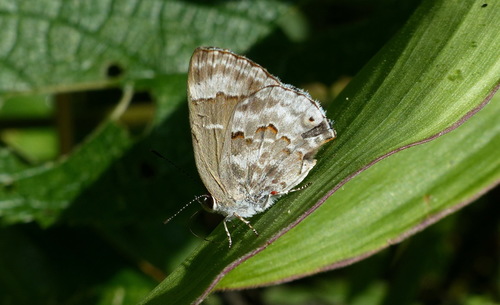
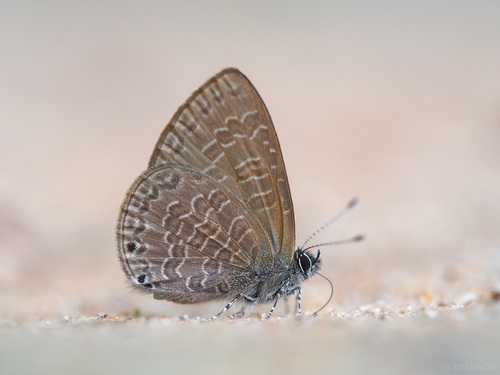
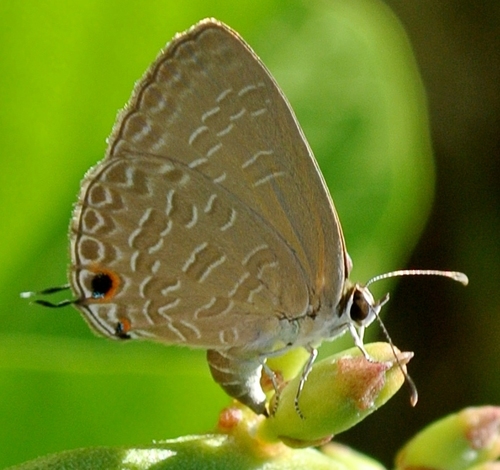
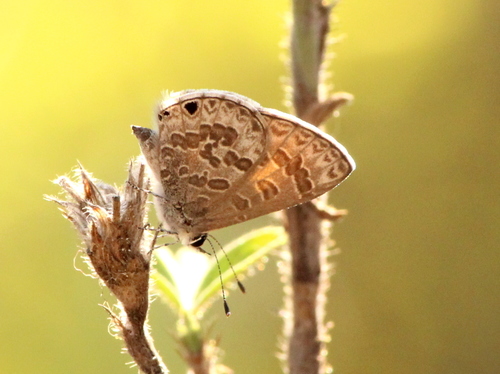
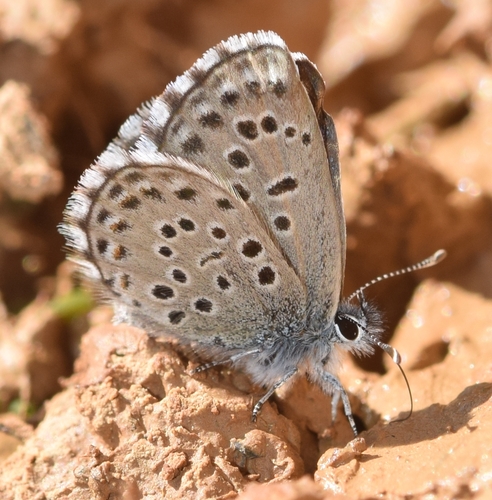
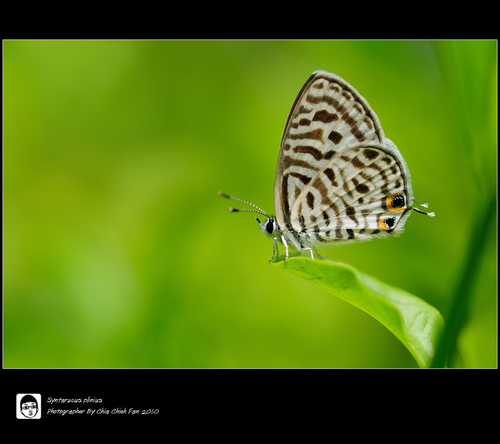
Male: Upperside is dark violet, with a rich blue suffusion that becomes visible in certain lights. The forewing does not have a discocellular black spot as prominent as the one found in T. theophrastus. The terminal margin of the forewing has a narrow fuscous black edging, which is widest at the apex and gradually narrows toward the tornus. This edging is followed by an inconspicuous anteciliary jet-black line. On the hindwing, the costal margin is slightly but broadly shaded with fuscous, which continues as a slender anteciliary black line to the tornus. The underside is white. The forewing has the following brownish-black markings: an irregular edging along the costa extending to near the apex, from which a subbasal band extends downwards, broadening across the cell and the area below the cell; an irregular band that runs along the discocellulars and below them to interspace 1, ending in a point; a curved upper discal band of more even width that is dislocated below vein 4, with its lower portion shifted inwards to form a large quadrate spot in interspace 3. Below vein 3, the band continues downwards via two small inconspicuous spots, and beyond these spots sits a very short, acutely pointed comma-shaped mark; there is also a very regular, evenly curved complete transverse lunular line, a transverse series of subterminal spots, and an anteciliary slender line. Close to the wing base, a triangular mark extends obliquely upwards and outwards from the dorsum; the white edging of the ground colour left near the base forms an acute angle above the apex of this triangular mark. Between the band that crosses the middle of the cell and the transverse discocellular band lies a more or less slender, irregular line of the same brownish-black colour. Between the discocellular and upper discal bands there is another much shorter line that extends downwards from the costa but does not reach vein 4, and this line is slightly club-shaped at both its anterior and posterior ends. The hindwing is mottled with brownish black, which leaves only basal, subbasal, medial and discal transverse lines or bands of the white ground colour. The highly irregular medial and discal bands enclose small brownish markings in places, and the bands themselves coalesce above a very irregularly shaped brown mark located on the posterior half of the wing's midsection. Terminal markings match those of the forewing, but the subterminal spots are larger, especially the apical one. The two tornal spots are jet-black and each is surrounded by a glittering, slender ring of metallic green scales. The cilia of both forewings and hindwings, along with the antennae, head, thorax and abdomen are much the same as in T. theophrastus.
Female: Upperside very closely matches the upperside of female T. theophrastus, but covers a larger extent of white on the forewing. This means more white area is visible between the brown markings overlaid on the white background, and these markings form the shape of an irregular V against the white background. The hindwing is much the same as in T. theophrastus. The underside is similar to that of the male of this species, but the brown bands are less broken and more regular. Cilia, antennae, head, thorax and abdomen match those of the male.
This species is found in the Ethiopian region, from the north-western Himalayas to Kumaon, the plains of northern India, central and western India, Sri Lanka, Assam, Myanmar, and the low hot northern valleys of Tenasserim. Its distribution extends to China and through the Malayan subregion to Java.
The description above is of wet-season brood males and females. Dry-season brood specimens are paler on the upperside; males only have anteciliary black lines on the wings. On the underside, the wing markings are very similar when examined closely, but they are paler brown and all greatly reduced in width, which leaves a larger area of the white ground colour visible.
Known host food plants belong to the legume family, Plumbaginaceae, and the citrus family Rutaceae. Confirmed food plant species include Glycine tomentella, Dyerophytum indicum, Indigofera suffruticosa, Lablab purpurea, Plumbago zeylanica, Rhynchosia tomentosa, Sesbania bispinosa, Tephrosia obovata, Ziziphus mauritiana, Indigofera argentea, Indigofera erecta, Medicago sativa and Toddalia asiatica.