About Leptospermum scoparium Forst.
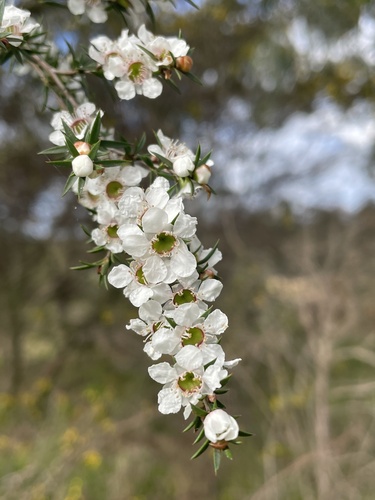
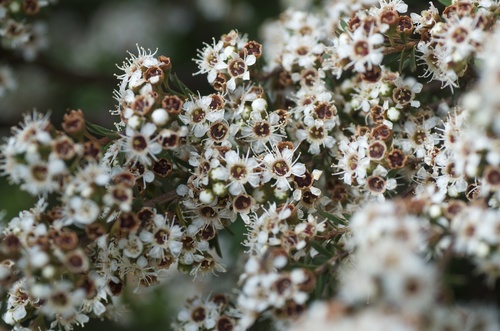
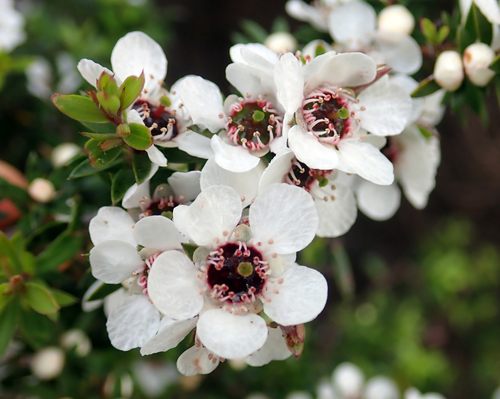
This plant species, commonly known as mānuka, has the scientific name Leptospermum scoparium Forst. Mānuka is a prolific shrub-type tree, and is often one of the first species to regenerate on cleared land. It typically grows as a 2–5 m (7–16 ft) tall shrub, but can develop into a moderately sized tree reaching up to around 15 m (49 ft) in height. It is evergreen, with dense branching and small leaves that measure 7–20 mm (0.28–0.79 in) long and 2–6 mm (0.079–0.24 in) broad, ending in a short spine tip. Its flowers are white, occasionally pink, with a diameter of 8–15 mm (0.31–0.59 in) – rarely growing up to 25 mm (0.98 in) across – and have five petals. The wood of mānuka is tough and hard. Mānuka is often confused with the related species kānuka (Kunzea ericoides). The simplest way to distinguish the two species in the field is by feeling their foliage: mānuka leaves are prickly, while kānuka leaves are soft. Another difference is that mānuka seed capsules measure 5–7 mm or 0.20–0.28 inches in diameter, are large, and often remain on the plant year round, while kānuka seed capsules are much smaller at 2.2–4.6 mm or 0.087–0.18 inches in diameter, and are not present on the plant for most of the year. Evidence suggests that Leptospermum scoparium originated in Australia before the onset of Miocene aridity, and dispersed to New Zealand from eastern Australia via long-distance dispersal events sometime within the last 20 million years. Cyclones and other wind activity are the most likely cause of long-distance seed transport. Supporters of this origin theory note that the genus Leptospermum evolved under conditions with frequent forest fires (found in Australia, not in temperate New Zealand), as members of the genus have fire-adaptive traits including serotiny and storage lignotubers. It has been hypothesized that after arriving in New Zealand, L. scoparium became established only in limited edaphically suitable areas until the arrival of Polynesian people. Polynesian fire use and forest clearing created the low-nutrient soils that L. scoparium was already preadapted to from its Australian homeland. Mānuka is now more common in New Zealand than it is in Australia. It grows throughout New Zealand, and is particularly common on the drier east coasts of the North and South Islands. In Australia, it is found in Tasmania, Victoria and New South Wales. Mānuka is one of the few native New Zealand species adapted to fire. After a fire event, it responds by opening seed pods and allowing seeds to disperse across recently disturbed ground. Numerous cultivars have been developed for garden use. The following cultivars have earned the Royal Horticultural Society's Award of Garden Merit: (Nanum Group) 'Kiwi', 'Nichollsii Nanum', 'Red Damask', 'Silver Sheen'. Many additional cultivars are available in New Zealand, but the species often grows better in cultivation outside of New Zealand. This is because in its native range, mānuka is attacked by scale insects that secrete honeydew, on which sooty mould grows and eventually debilitates the plant. Because of this issue, attempts have been made to cross showy New Zealand cultivars with mould-resistant Australian Leptospermum species, with limited commercial success. In traditional Māori culture, mānuka had a wide variety of uses. It was used as a building material for items including combs, paddles, and digging sticks, to build eel weirs, for making weaponry, and to construct palisade walls for pā. It also had uses in traditional rongoā Māori medicine: infusions were made from its leaves, or mānuka gum was collected for use. Its wood was commonly used for tool handles. Mānuka sawdust gives a distinctive flavour when used to smoke meats and fish. It is cultivated in Australia and New Zealand to produce mānuka honey, made when honeybees collect nectar from its flowers, and to supply the pharmaceutical industry. It is also used for carving. An essential oil, for which many medicinal claims are made, is produced via steam distillation of its leaves. Mānuka, the name most New Zealanders use for this plant, was used by Māori before European arrival and remains in use today. A leaf decoction was drunk to treat urinary complaints and used as a febrifuge, an agent to reduce fever. Steam from leaves boiled in water was inhaled to treat head colds. A decoction made from leaves and bark was prepared, and the warm liquid was rubbed on stiff muscles and aching joints. The emollient white gum, called pai mānuka, was given to nursing babies and also used to treat scalds and burns. Chewing the bark is said to have a relaxing effect and improve sleep. Mānuka leaves are also used as a flavouring agent in craft beers and tonics.