About Leptospermum petersonii F.M.Bailey
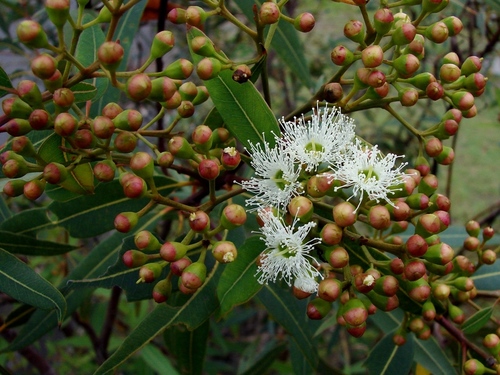
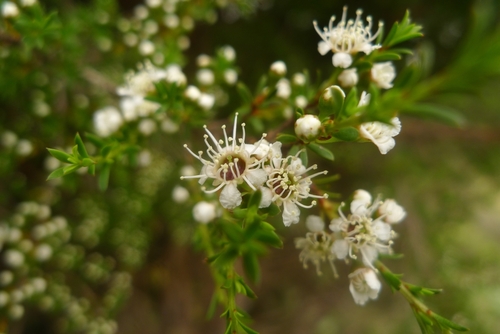
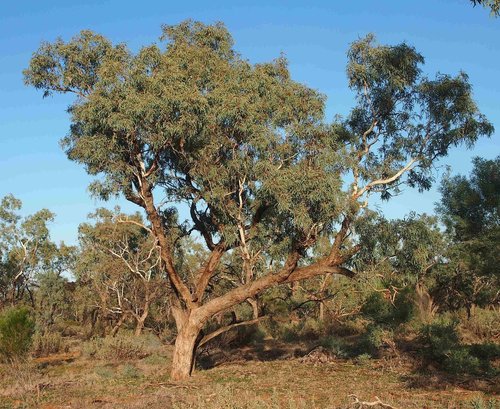
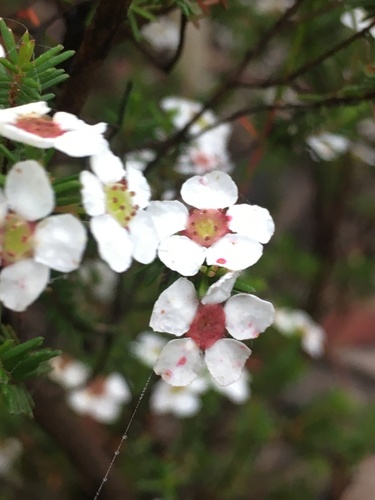
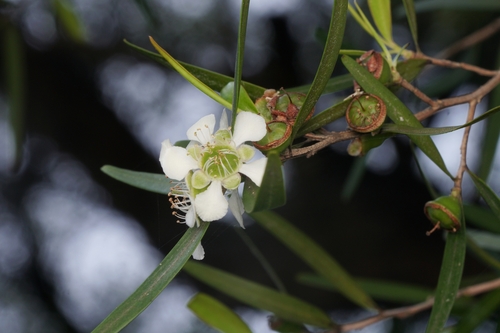
Leptospermum petersonii, commonly called lemon-scented teatree, is a shrub or small tree that usually grows to around 5 meters (16 feet) or more in height. Its stems have thin, rough, fibrous or flaky bark, and its branchlets are glabrous, with a flange under the base of each leaf. New growth is often tinted red or purple. The leaves are elliptical to narrow lance-shaped, typically 20–40 mm (0.79–1.57 in) long and 2–5 mm (0.079–0.197 in) wide, often strongly scented, and lack a petiole. The flowers are white, around 10–15 mm (0.39–0.59 in) in diameter, and usually grow singly on short side shoots. The base of flower buds has thin, papery, reddish-brown bracts and bracteoles, which most often fall off as the bud develops. The floral cup is mostly glabrous and dark-coloured, measuring 3–4 mm (0.12–0.16 in) long. The sepals are hemispherical, 1.5–2.5 mm (0.059–0.098 in) long, the petals 5–6 mm (0.20–0.24 in) long, and the stamens 2.5–3.5 mm (0.098–0.138 in) long. Flowering occurs mainly from December to January, and the fruit is a capsule around 6 mm (0.24 in) wide. The capsules stay attached to younger stems, but are shed as the plant ages. In its natural range, lemon-scented teatree grows in sclerophyll forest or rainforest near creeks or on rocky escarpments, ranging from Mount Timbeerwah in south-east Queensland south to near Port Macquarie in New South Wales. This teatree is commonly cultivated in gardens, and sometimes spreads from these planted areas. It has become naturalized in locations outside its native range, including native vegetation near Sydney and Melbourne, and in Hawaii. In horticulture, lemon-scented teatree is a widely known garden plant, popular for its scent and attractive appearance. It grows quickly and can be maintained at shrub height with pruning. Its tolerance for regular pruning also makes it well suited for use in hedges and windbreaks, and for harvesting to distill essential oils.